
Same PPTC Name, Very Different Protection Performance? The Hidden Gap Defined by Material Formulation
Same Specifications Do Not Mean Same Performance
When selecting a PPTC resettable fuse, engineers usually begin by comparing basic parameters such as hold current, trip current, maximum operating voltage, maximum fault current, and initial resistance. These parameters are essential for selection, but they do not fully represent how the device will protect a real circuit. Even when two PPTC devices appear to have the same package size, rated current, and rated voltage, their actual trip speed, post-trip resistance recovery, cycle stability, and high-temperature behavior may differ significantly.These differences usually come from the material formulation. A PPTC is a composite material made from a polymer matrix and conductive particles. How material formulation affects protection performance depends on the crystallinity of the polymer matrix, the type and dispersion of conductive particles, the degree of crosslinking, and how well the manufacturing process controls the conductive network. When an overcurrent event occurs, the material must heat up and expand quickly enough to break the conductive paths, causing resistance to rise rapidly. After the fault is removed, the material must shrink and rebuild the conductive network so that resistance returns to an acceptable range.
Therefore, not all PPTC devices deliver the same protection performance, even if they share the same basic name. The real technical barrier is not simply making a device that changes resistance, but consistently controlling the material formulation, conductive network, and long-term reliability. For engineering selection, performance comparison should not stop at the first page of the datasheet. Engineers should also review trip curves, temperature derating, post-trip resistance recovery, and cycling test results.
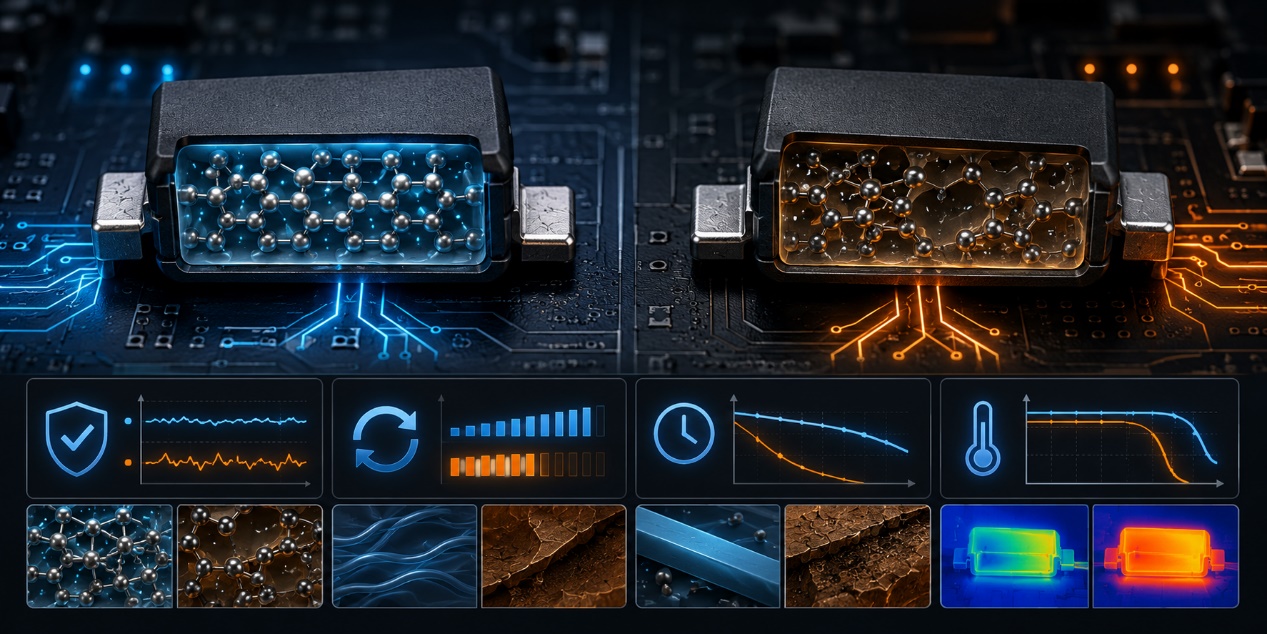
Four Key Indicators Affected by Formulation
The impact of material formulation on protection performance can be evaluated through four key indicators: trip consistency, post-trip resistance recovery, lifetime and aging, and trip speed with temperature derating.Trip Consistency
Trip consistency refers to whether PPTC devices from the same production lot show similar trip behavior under the same test conditions. If the material formulation is stable and the conductive particles are evenly dispersed, the device can usually enter a high-resistance state within a predictable time. If the conductive particles are poorly dispersed, the actual trip time may vary significantly even when the hold current and trip current are the same.
For system design, trip consistency is critical. If multiple PPTC devices are used in the same product but their trip times vary too much, part of the circuit may already be overheating before the protection device limits the current. In other cases, some devices may trip prematurely during normal startup current. These issues are often not visible from the datasheet alone; they come from differences in formulation design and process control.
Post-Trip Resistance Recovery
Post-trip resistance recovery is an important indicator of PPTC quality. After a PPTC trips, it enters a high-resistance state. Once the fault is removed and the device cools down, the material should shrink, allowing conductive particles to move closer together and resistance to return to an acceptable range. However, the resistance recovery capability can vary greatly between different formulations. Some devices may reset, but their post-trip resistance remains too high, which can increase voltage drop, cause startup issues, or raise the risk of repeated nuisance tripping at high temperatures.
Therefore, performance comparison should not focus only on initial resistance. Engineers should also review post-trip resistance, R1max, resistance change after thermal cycling, and resistance drift after repeated trip cycles. A good formulation must not only allow the device to trip, but also help it return reliably to a low-resistance state after cooling.
Lifetime and Aging
A PPTC is a resettable protection device, but resettable does not mean the material never ages. Every trip and reset cycle exposes the polymer matrix to heating, phase transition, expansion, cooling, and structural rearrangement. If the formulation is stable, these changes can be controlled within an acceptable range. If the formulation or process control is weak, repeated thermal cycling may gradually degrade the conductive network, causing post-trip resistance to increase, trip time to shift, or long-term reliability to decline.
High temperature, high humidity, long operation near rated current, frequent surge events, and poor heat dissipation can all accelerate material aging. PPTC suppliers with strong technical capability usually do not focus only on initial performance. They also use reliability testing to verify long-term stability after extended operation and repeated protection cycles.
Trip Speed and Temperature Derating
PPTC protection is based on a resistance jump caused by material heating, so formulation directly affects trip speed. If the phase transition range of the polymer matrix is properly designed and the conductive network is well controlled, the device can enter a high-resistance state quickly when abnormal current appears. If the formulation is not well designed, the device may trip too slowly, allowing traces, connectors, or loads to withstand excessive thermal stress for too long.
Ambient temperature also affects PPTC behavior. At high temperatures, the material is closer to its trip condition, so the hold current decreases. At low temperatures, the device may require more energy before it trips. A strong formulation should perform well not only at 25°C, but also maintain a stable and predictable temperature derating curve under high-temperature, low-temperature, and different thermal conditions.
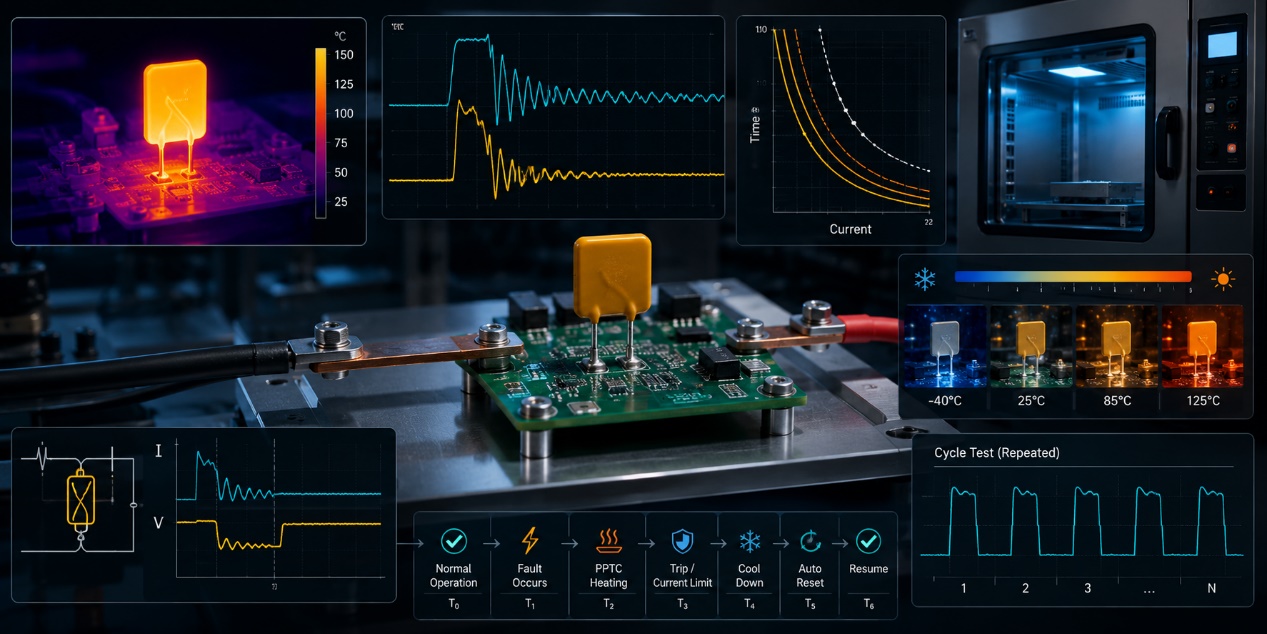
How to Verify Real Material Performance
To evaluate the protection performance of a PPTC, engineers should not rely only on datasheet values. Many parameters are measured at 25°C under standard thermal conditions and fixed test currents, while real products may face high ambient temperature, enclosed spaces, inrush current, repeated overloads, and PCB heat dissipation differences. Testing under actual application conditions is therefore necessary to verify real material performance.
First, review the time-to-trip curve. Even when two devices have the same trip current, different formulations may show different trip speeds at different fault-current levels. If the curves are widely scattered, the formulation or manufacturing consistency may be insufficient.
Second, review the temperature derating curve. PPTC hold current decreases as ambient temperature rises. A stable material should provide a smooth and predictable derating behavior, reducing the risk of nuisance tripping at high temperature or insufficient protection under fault conditions.
Third, review post-trip resistance and cycling tests. Engineers should compare initial resistance, resistance after trip, resistance after cooling, and resistance drift after repeated trip cycles. If post-trip resistance increases too much, it may lead to higher voltage drop, increased self-heating, or system startup difficulties.
Fourth, review long-term aging and reliability data. High-temperature storage, damp heat testing, powered aging, thermal cycling, and repeated trip testing can reveal formulation differences that are not visible on the first page of the datasheet. These tests also help determine whether the supplier truly has material and process control capability.
What Procurement and Product Managers Should Ask Suppliers
When evaluating PPTC devices, procurement teams and product managers should not ask only about price, lead time, and replacement part numbers. They should also confirm whether the device is stable and reliable under real application conditions.
First, ask about test conditions. Under what ambient temperature, test current, and thermal conditions were the supplier’s hold current, trip current, time-to-trip, and initial resistance measured? If only 25°C single-point data is available, without high-temperature, low-temperature, and current-multiple curves, it is difficult to judge actual protection capability.
Second, ask about post-trip resistance and repeated trip performance. The value of a PPTC is not only that it can trip, but that it can return to a usable state after the fault is removed. Procurement teams and product managers should confirm initial resistance, post-trip resistance, R1max, and resistance drift after repeated trip cycles.
Third, ask about material and process stability. Can the supplier provide reliability test data, lot-to-lot control methods, and long-term supply consistency? A PPTC supplier with real technical capability does not merely provide qualified samples; it must maintain stable quality throughout mass production.
Finally, ask about application support capability. When a product experiences nuisance tripping, slow tripping, or poor recovery, can the supplier help determine whether the root cause is selection, heat dissipation, surge current, ambient temperature, or material limitation? This engineering support capability often reduces mass-production risk more effectively than a lower unit price.
FAQ
Why do PPTC devices with similar specifications perform differently?Because actual PPTC performance is affected by material formulation, conductive particle dispersion, crosslinking level, polymer crystallinity, and process stability. Even when specifications look similar, different products may behave differently in trip speed, post-trip resistance recovery, temperature derating, and repeated trip stability.
How does material formulation affect protection performance?
Material formulation determines whether a PPTC can quickly enter a high-resistance state when heated, and whether it can recover to a stable low-resistance state after cooling. The polymer matrix, conductive filler, filler loading ratio, and dispersion uniformity all affect the formation, breakage, and reconstruction of the conductive network.
Why is datasheet comparison alone not enough?
Datasheets usually provide data measured under standard conditions, while real products may face high temperature, surge current, enclosed thermal environments, and repeated overloads. PPTC performance comparison should include trip curves, temperature derating, post-trip resistance, cycling tests, and aging data.
Why is the technical barrier hidden in material formulation?
The technical barrier of PPTC technology lies in long-term control of material formulation and manufacturing process. Polymer matrix selection, conductive particle dispersion, crosslinking control, and lot-to-lot consistency all affect final protection performance.
What is most often overlooked when replacing a PPTC part number?
The most common mistake is comparing only size, current, voltage, and price while ignoring post-trip resistance, trip curves, temperature derating, and repeated trip stability. These hidden differences may lead to nuisance tripping, insufficient protection, abnormal startup, or reliability issues after mass production.
Conclusion and Material Comparison Consultation CTA
Not all PPTC devices deliver the same protection performance. The real difference is not only in package size, hold current, trip current, or maximum operating voltage, but in material formulation, conductive network control, manufacturing process, and reliability validation.From an engineering perspective, the key to understanding how material formulation affects protection performance lies in the microscopic balance between the polymer matrix and conductive particles. When overcurrent occurs, the material must expand quickly and break the conductive paths, allowing the device to enter a high-resistance state. After the fault is removed, the material must shrink in a controlled way so that post-trip resistance remains within an acceptable range.
Therefore, engineers, procurement teams, and product managers should not compare PPTC devices only by part number cross-reference or datasheet values. They should also review time-to-trip curves, temperature derating curves, initial resistance, post-trip resistance, cycling tests, and aging data. Only by evaluating material formulation, process stability, and system requirements together can teams reduce the risk of wrong selection, nuisance tripping, insufficient protection, and customer complaints after mass production.
If you are comparing different PPTC part numbers or evaluating whether your current protection device is suitable for your application, we welcome you to discuss material comparison and selection review with us. We can help you build a more complete performance comparison based on material formulation, electrical characteristics, temperature derating, post-trip resistance, trip curves, and reliability data.
Schedule a PPTC material comparison consultation to understand formulation differences, performance comparison, and long-term reliability considerations.