
Polymer PTC Material Principles: How One Component Can “Sense Temperature and Cut Off Current” by Itself
Understanding the PTC Effect Through a Simple Everyday Analogy
To explain polymer PTC material principles in one sentence, imagine a road that changes its width according to temperature. Under normal conditions, the road is wide and vehicles can pass through smoothly. But when traffic becomes too heavy and the road heats up, the road automatically narrows, reducing the traffic flow and even temporarily preventing excessive traffic from continuing. Once the temperature drops, the road returns to its original width and traffic can pass again.This is the basic protection logic of a polymer PTC component: when temperature rises, resistance increases sharply; when temperature falls, resistance can gradually recover. PTC stands for Positive Temperature Coefficient. The PTC effect means that a material’s resistance increases as temperature rises. In polymer PTC materials, this change is not a slow, linear increase. Instead, resistance rises dramatically within a specific temperature range.
Therefore, when a circuit experiences overcurrent, short circuit, motor stall, battery abnormality, or high ambient temperature, the polymer PTC component enters a high-resistance state as its temperature increases, limiting the current from continuing to flow. It does not require an external sensor or control IC. Instead, it relies on the physical changes of the material itself to achieve self-temperature sensing, self-current limiting, and self-protection.
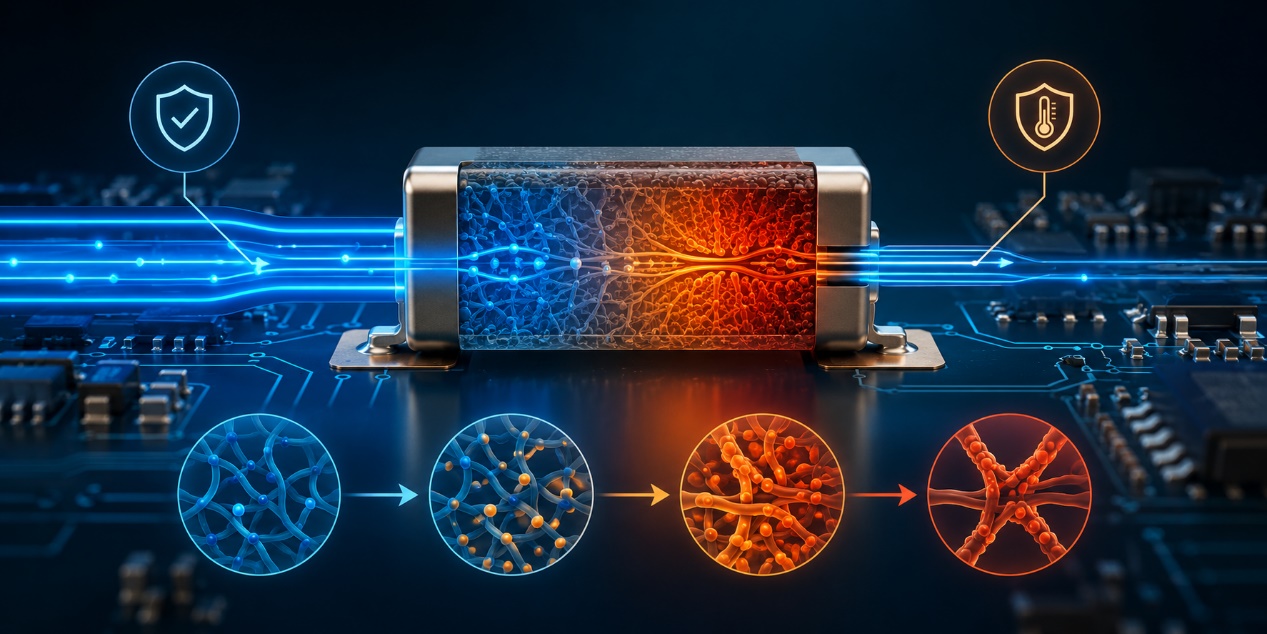
Material Structure: Polymer Matrix + Conductive Particles
The core structure of a polymer PTC material can be simplified as a functional composite material made of a polymer matrix plus conductive particles. It does not rely on one single material to perform the protection function. Instead, it uses the thermal expansion behavior of the polymer material and the contact relationship between conductive particles to form a material system whose resistance changes with temperature.
The polymer matrix usually acts as the supporting framework. Common materials include polyethylene-based polymers, fluoropolymers, or other polymers with suitable crystalline properties. These matrices can maintain structural stability at room temperature and allow conductive particles to be evenly dispersed within the material. When the temperature approaches the phase transition or melting region of the material, the matrix expands significantly, changing the distance between the conductive particles.
Conductive particles are the main source of electrical conductivity. Common fillers include carbon black, graphite, metal powders, carbon nanotubes, and other conductive fillers. Among them, carbon black is a typical conductive material used in polymer PTC components. When these conductive particles reach a certain concentration in the polymer matrix and become close enough to one another, they form continuous or semi-continuous conductive networks that allow current to pass through.
In other words, the conductivity of polymer PTC materials does not mainly come from the polymer itself. It comes from the conductive paths built by conductive particles inside the material. When the temperature is normal, the particles are close enough to each other and the resistance remains low. When temperature rises, the matrix expands, the particles are pushed apart, the conductive network is disrupted, and resistance increases rapidly.
What Happens Inside When Temperature Rises
When the temperature of a polymer PTC component rises, its internal response does not come from a mechanical switch opening, nor from a control IC sending a shutdown command. Instead, the microscopic structure of the material itself is changing. This is the core of polymer PTC material principles: the component can sense temperature and limit current by itself because the polymer matrix expands as temperature increases, changing the contact condition between conductive particles.
During normal operation, conductive particles are close to one another and form multiple conductive paths inside the material, keeping the component in a low-resistance state. However, when the circuit experiences overcurrent, short circuit, motor stall, or excessive ambient temperature, the current flowing through the component generates Joule heat, causing the material temperature to rise.
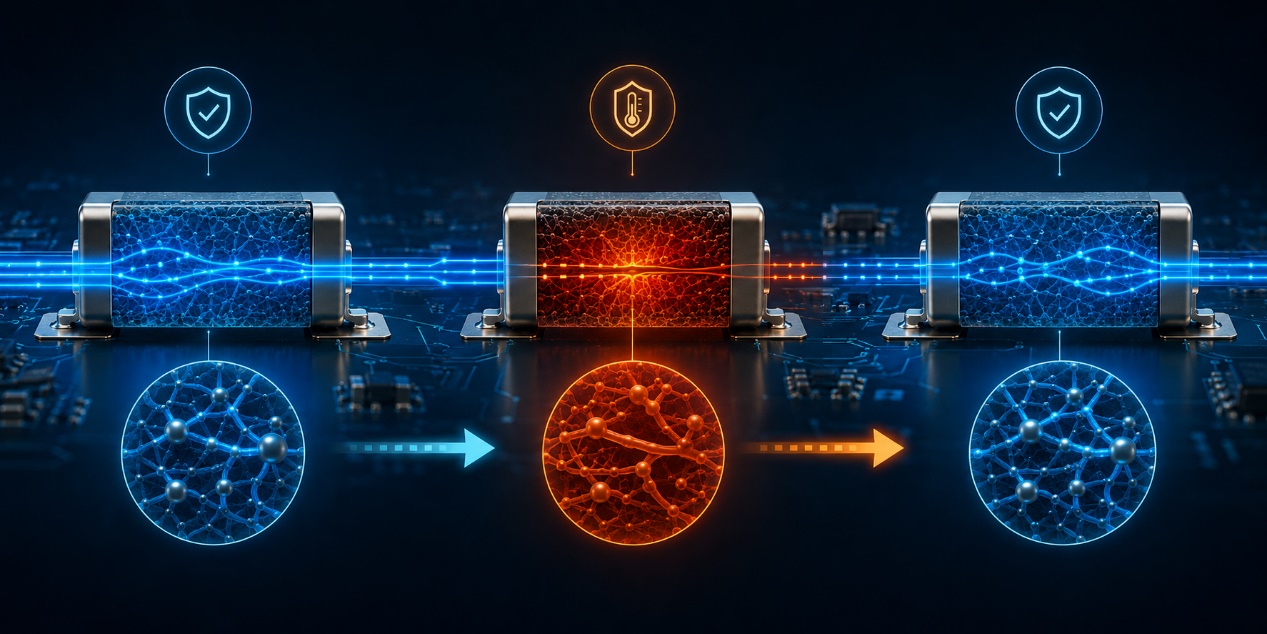
Volume Expansion and Conductive Path Disconnection
When the temperature approaches the specific transition range of the polymer matrix, the material begins to expand significantly. This expansion pushes apart the conductive particles that were originally close together, reducing the number of contact points between them. The conductive network that originally allowed electrons to pass begins to loosen, separate, and even disconnect as the particle spacing increases.
This process can be imagined as a net made of many small metallic points being stretched open by a heat-expanded polymer material. When there are enough connection points, current can pass through. But once the particles are no longer in close contact and the conductive paths are broken, resistance rises rapidly. This phenomenon, in which resistance increases sharply with temperature, is the typical PTC effect.
Therefore, the “cut-off” behavior of a polymer PTC component is more accurately described as current limiting through a sharp resistance increase. It does not reduce the current completely to zero. Instead, it lowers abnormal current to a more controlled level, reducing the risk of overheating damage to traces, batteries, motors, connectors, or electronic components.
Why Resistance Rises Sharply
The unique feature of a polymer PTC component is not only that resistance increases as temperature rises, but that resistance rises almost “step-like” once temperature reaches a critical range. The resistance of ordinary conductors may change gradually with temperature. In contrast, the resistance change in polymer PTC materials comes from the sudden disruption of the internal conductive network, making the response much more obvious.
At normal temperature, conductive particles are close to one another and form multiple paths for current flow. As long as these paths remain intact, the component stays in a low-resistance state. However, when the temperature rises to the softening, crystalline transition, or melting-related range of the polymer matrix, the material volume expands rapidly. This expansion directly breaks the contact points originally established between particles, turning a continuous conductive network into a discontinuous state within a short time.
This can be understood through the idea of a “critical point.” Conductive particles must reach a certain level of connectivity for the material to show good conductivity. Once the number of particle contacts falls below the critical level, the available current paths suddenly decrease significantly. What was once many available roads for current flow instantly becomes only a few narrow passages. As a result, the material resistance rises sharply.
From a materials perspective, polymer PTC material is a special type of conductive polymer composite. Its conductivity is not fixed. It is jointly influenced by the thermal expansion of the polymer matrix, the dispersion state of conductive particles, and the interfacial structure between them. When temperature changes increase the spacing between particles, the material’s temperature coefficient rises rapidly within a specific range, causing a significant jump in resistance.
What This Means for Component Selection
Understanding polymer PTC material principles is critical for component selection because a PPTC cannot be selected simply by looking at “rated current.” Its protection behavior comes from material temperature change and resistance increase. Therefore, engineers must consider operating current, ambient temperature, thermal dissipation conditions, trip time, maximum operating voltage, and maximum fault current at the same time.
The two most basic parameters are hold current and trip current. Hold current is the maximum current that the component can carry continuously at a specified ambient temperature without entering a high-resistance state. Trip current is the minimum current that will cause the component to enter a protection state under the same conditions. Because polymer PTC materials have a positive temperature coefficient, the higher the ambient temperature, the easier it is for the component to accumulate heat. As a result, the available hold current decreases.
This is why engineers cannot select a part based only on the 25°C specification. Temperature derating must be applied according to the actual operating temperature. If the component is installed in an enclosed space, placed near a heat source, or mounted on a PCB with insufficient copper area for heat dissipation, its material temperature will rise faster. The conductive paths inside the conductive polymer will be disrupted more easily, causing the component to enter a high-resistance state earlier. Conversely, if heat dissipation is very effective, the component may take longer to trip.
Therefore, when selecting a polymer PTC component, engineers should first confirm that the normal operating current is lower than the derated hold current. They should then confirm that the fault current is higher than the trip current, and verify that the maximum operating voltage and maximum fault current are within the specified ratings. For applications such as motors, batteries, USB ports, communication ports, industrial control modules, or automotive electronics, startup inrush current, stall current, high ambient temperature, and repeated trip cycles must also be evaluated.
FAQ
What are polymer PTC material principles?Polymer PTC material principles refer to the behavior in which a material’s resistance increases significantly as temperature rises, thereby limiting current flow. These materials are typically composed of a polymer matrix and conductive particles. At normal temperature, the conductive particles form a conductive network that allows current to pass. When temperature rises, the polymer matrix expands, the conductive particles separate, the conductive paths disconnect, and resistance increases rapidly.
What does the PTC effect mean?
The PTC effect stands for Positive Temperature Coefficient effect. It means that a material’s resistance increases as temperature rises. In polymer PTC components, this change is usually not a slow linear increase. Instead, resistance rises sharply within a specific temperature range, making the material suitable for overcurrent protection and automatic current limiting.
Can a polymer PTC component really cut off current by itself?
Strictly speaking, a polymer PTC component does not completely cut off current like a mechanical switch. Instead, it sharply increases resistance and limits current to a lower level. Therefore, its “self-cutoff” behavior is more accurately described as “self-temperature sensing and entering a high-resistance state,” preventing abnormal current from continuing to increase and reducing the risk of overheating or component damage.
Is the conductive polymer itself electrically conductive?
In PPTC materials, conductivity mainly does not come from the polymer matrix itself. It comes from conductive particles dispersed inside the material, such as carbon black, graphite, or other conductive fillers. When these particles are close enough to one another, they form a conductive network that gives the material controllable electrical conductivity. Therefore, polymer PTC material is more accurately described as a conductive polymer composite.
Why does ambient temperature affect PPTC selection?
Because the operation of a polymer PTC component is closely related to material temperature. The higher the ambient temperature, the easier it is for the component to accumulate heat and enter a high-resistance state. Therefore, under high-temperature conditions, the component’s available hold current decreases. If engineers only refer to the 25°C specification without applying temperature derating, the design may suffer from nuisance tripping or insufficient protection.
Can polymer PTC replace a traditional fuse?
Polymer PTC and traditional fuses use different protection mechanisms. A traditional fuse is usually a one-time protection device that melts open and must be replaced after operation. A polymer PTC component can recover to a lower resistance state after the abnormal condition is removed and the component cools down, providing resettable protection. For applications that require repeated protection, lower maintenance cost, or avoidance of one-time replacement, polymer PTC is a common option. However, in high-voltage, high-fault-current, or full-open-circuit applications, specifications and safety requirements must still be carefully evaluated.
Conclusion and Technical White Paper CTA
The reason a polymer PTC component can “sense temperature and cut off current by itself” does not lie in an external control circuit. It lies in the material’s ability to change resistance with temperature. From the perspective of polymer PTC material principles, this type of component is a conductive polymer composite made of a polymer matrix and conductive particles. Under normal operating temperature, the conductive particles form a stable conductive network that allows current to pass. When overcurrent, short circuit, motor stall, or high ambient temperature causes the component to heat up, the polymer matrix expands, the particle spacing increases, the conductive paths are disrupted, and resistance rises sharply, limiting current to a lower level.This material-structure-driven PTC effect is the core value of PPTC resettable overcurrent protection. It does not need to be replaced immediately after operation like a traditional fuse, nor does it need to rely on an external control signal. Instead, it uses its positive temperature coefficient behavior to enter a high-resistance state during an abnormal condition, then gradually recover to a low-resistance state after the abnormal condition is removed and the component cools down. For electronic products that require long-term reliable operation, this material-level protection mechanism can reduce maintenance frequency, improve system robustness, and help engineers balance space, cost, and safety.
If you are evaluating PPTC components for a new product design, or if you would like to better understand polymer PTC materials, the PTC effect, temperature coefficient behavior, derating design, and component selection methods, we invite you to request our technical white paper. This white paper will help you build a more complete PPTC protection design framework from four perspectives: material principles, electrical parameters, application scenarios, and common selection pitfalls.
Request the PPTC technical white paper now to master polymer PTC material principles and practical component selection essentials.