
Why Can a PPTC Reset Itself? The Engineering Logic Behind Material Phase Transition
Self-Recovery Is Not Magic — It Is Material Memory
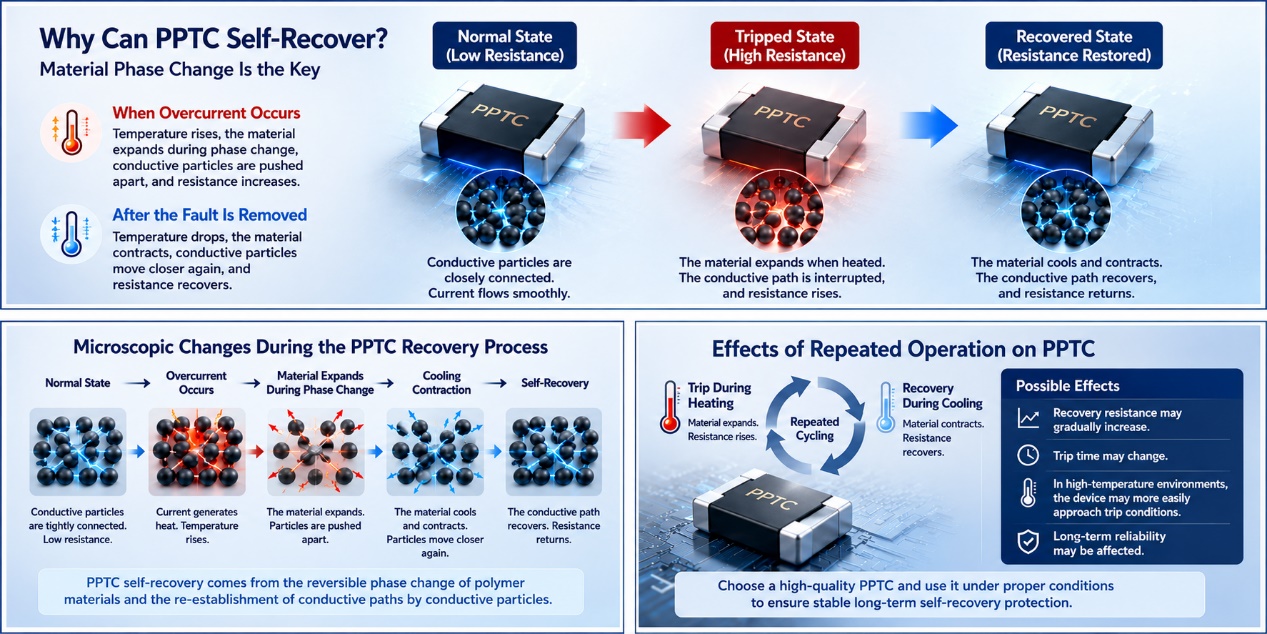
Why can a PPTC reset itself? The answer is not that there is a mechanical switch inside the device, nor that it relies on an IC to actively control the circuit. The key is that the polymer material itself can change structure when heated and partially return to its original state after cooling. From an engineering perspective, the resettable behavior of a PPTC comes from material phase transition, recrystallization, and the reformation of conductive paths as conductive particles move closer together again.
A PPTC is typically made of a polymer matrix and conductive particles. Under normal operating conditions, the polymer matrix maintains a stable crystalline or semi-crystalline structure. The conductive particles remain close enough to form a conductive network, allowing current to pass through the device. In this state, the PPTC stays in a low-resistance condition.
When an overcurrent, short circuit, or abnormal load occurs, the current generates Joule heat and raises the internal temperature of the material. As the temperature approaches the material’s phase-transition region, the polymer matrix expands. This expansion pushes the conductive particles apart, breaks the original conductive network, and causes the resistance to rise rapidly. The device then enters a high-resistance state and limits the fault current.
“Self-recovery” does not mean the device instantly returns to its original condition after tripping. Instead, after the fault is removed and the device cools down, the polymer matrix gradually contracts, part of the crystalline structure reforms, and the conductive particles move closer together again. The conductive network is rebuilt, allowing the resistance to recover to a range that can support normal operating current. This material-level memory effect is the core reason why PPTCs can provide repeated overcurrent protection.
Microscopic Changes During Tripping
When a PPTC trips, the visible result is current limiting, but the real change occurs inside the material. To understand why a PPTC can reset itself, it is necessary to first understand how it changes from a low-resistance state to a high-resistance state.
Under normal conditions, the polymer matrix maintains a relatively stable crystalline structure, while the conductive particles remain close to each other. Together, they form continuous or semi-continuous conductive paths. Current can pass through the device smoothly, and the PPTC remains in a low-resistance state. When the circuit experiences overcurrent, short circuit, motor stall, or abnormal loading, the current flowing through the device generates heat and quickly raises the material temperature.
When the temperature reaches a specific phase-transition range, the crystalline regions inside the polymer begin to loosen. The mobility of the polymer chains increases, and the volume of the matrix expands significantly. This expansion pushes the conductive particles apart and reduces the number of contact points between them. Once the number of conductive connections falls below a critical threshold, the original conductive network breaks down, and the resistance rises sharply.
Therefore, a PPTC does not trip by “burning open.” Instead, the material uses phase transition, expansion, and conductive-path interruption to increase its own resistance. This is how the device limits current and protects the circuit.
How Conductivity Recovers After Cooling
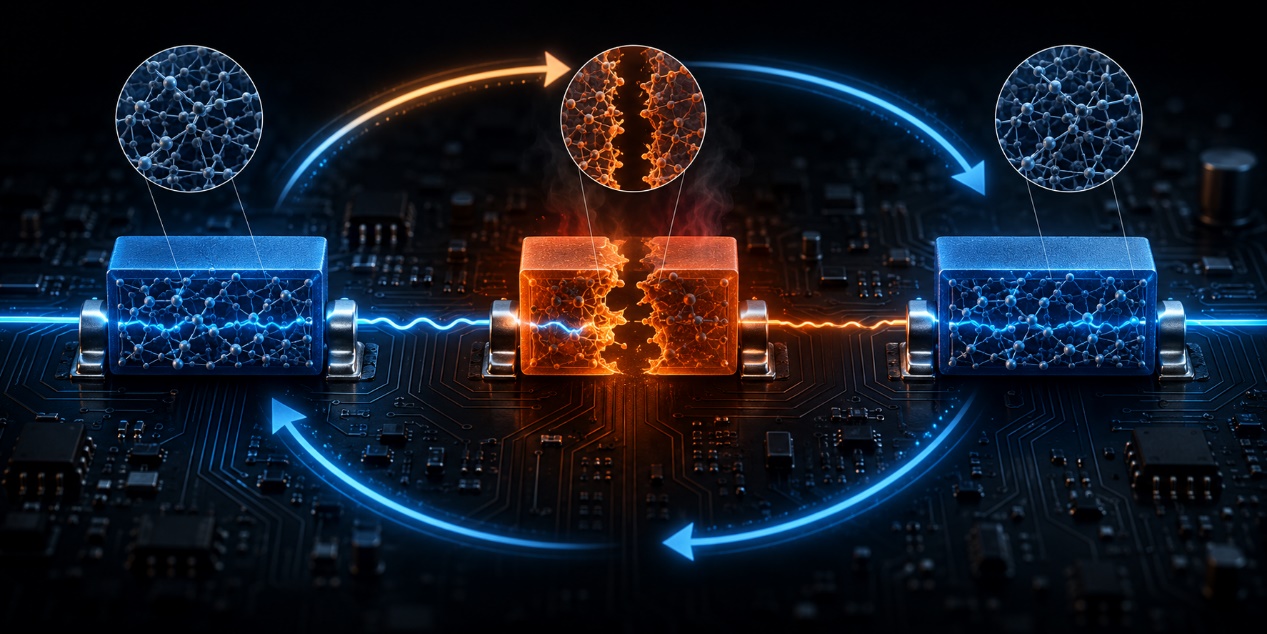
A PPTC is called a resettable fuse because it is not permanently damaged after tripping. Once the fault is removed and the temperature drops, the device can gradually recover its conductivity. During cooling, the polymer matrix begins to contract, part of the crystalline structure rearranges, the conductive particles move closer together, and the previously broken conductive paths are gradually rebuilt.
As long as the overcurrent or short-circuit condition remains, the PPTC stays hot and remains in a high-resistance state, continuing to limit current. Once the fault is cleared, the power is removed, or the load returns to normal, the current through the device decreases. Joule heating is reduced, and the device temperature begins to fall. As the temperature drops, the polymer matrix contracts from its expanded state, and the internal structure starts to return to a more stable condition.
During this process, crystalline regions within the material can reform or rearrange. Although the material may not return 100% to its original microscopic arrangement, matrix contraction shortens the distance between conductive particles. When the particles become close enough to establish contact or tunneling conduction paths, the conductive network recovers, and the device resistance drops from the high-resistance state back toward a lower-resistance state.
Therefore, the resettable behavior of a PPTC comes from the reversibility of material phase transition and the reformation of the conductive network. When heated, the material expands and interrupts conductive paths. When cooled, the material contracts, recrystallizes, and brings conductive particles closer together, allowing resistance recovery.
Why the Post-Trip Resistance May Increase Slightly
Although a PPTC can recover conductivity after cooling, “resettable” does not mean the resistance will always return exactly to its initial factory value. In real applications, after one or multiple trip events, the post-trip resistance may become slightly higher than the original value. This is because the material phase transition is reversible, but it is not a perfectly ideal reversible process.
During tripping, the polymer matrix expands as temperature rises. Conductive particles are pushed apart, and the conductive network breaks down. After cooling, the polymer contracts, and part of the crystalline structure rearranges, allowing the conductive particles to move closer again and restore conductive paths. However, the particle positions, crystalline arrangement, and interface conditions after cooling are usually not exactly the same as before tripping. If the number of contact points between conductive particles is slightly reduced, the recovered resistance may be somewhat higher.
This behavior can be viewed as microscopic memory caused by thermal history. If the trip temperature is high, the device remains in the high-resistance state for a long time, or the device experiences many repeated trip cycles, the crystalline structure, particle distribution, and interface contact conditions may change more noticeably. As a result, the resistance after recovery may remain higher than the initial value.
A slight increase in post-trip resistance does not necessarily mean device failure. As long as the resistance remains within the specified range and the device can still carry normal operating current, the PPTC can continue to provide resettable overcurrent protection. What engineers need to watch is whether the recovered resistance becomes too high, causes excessive voltage drop, affects load startup, or increases the risk of nuisance tripping at elevated temperatures.
Effects of Repeated Tripping on the Material
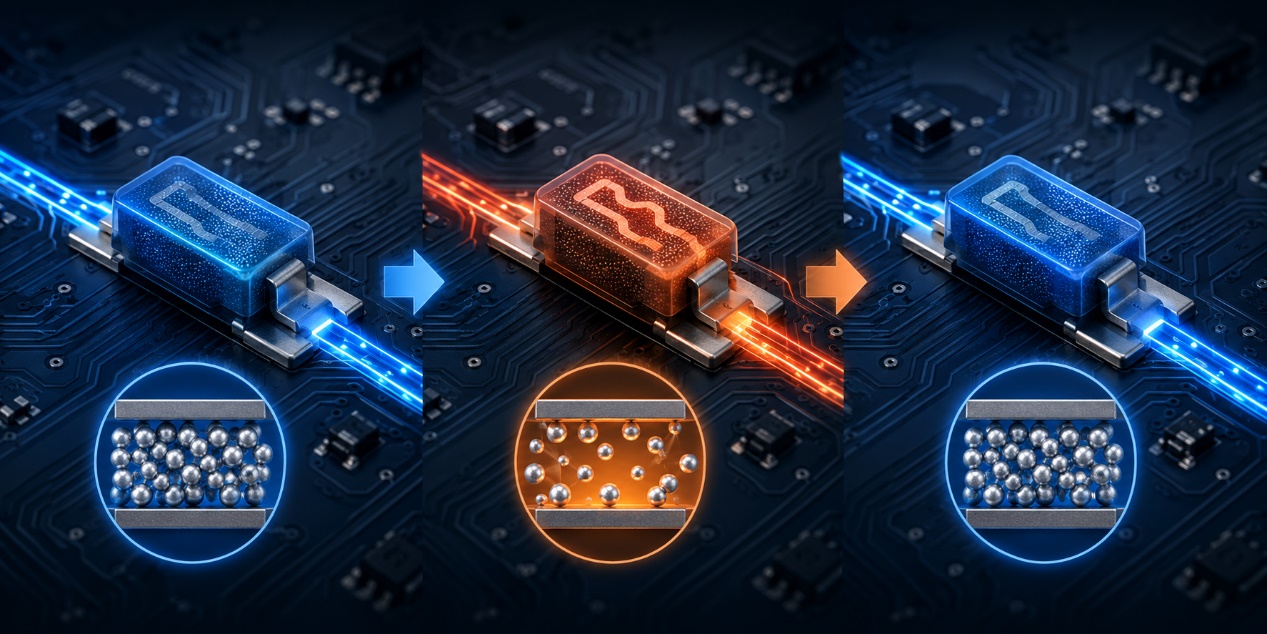
One major advantage of a PPTC is that it can recover after the fault is removed and the device cools down. Unlike a traditional fuse, it does not need to be replaced after every protection event. However, from a materials engineering perspective, repeated tripping and recovery are not completely free of impact. Each thermal cycle affects the polymer matrix, crystalline structure, and conductive particle distribution to some degree.
When a PPTC provides overcurrent protection, the material experiences heating, phase transition, volume expansion, conductive-path interruption, and resistance increase. After the fault is removed, the material then goes through cooling, contraction, recrystallization, and resistance recovery. This sequence is generally reversible, allowing the device to enter a high-resistance state and return to a low-resistance state multiple times.
However, repeated thermal cycling causes the material to accumulate thermal history. Over time, the recovered microscopic structure may gradually differ from the original condition. The most common effect is a gradual increase in post-trip resistance. This happens because conductive particles may not fully return to their original positions after being repeatedly pushed apart and brought back together. The crystalline regions of the polymer matrix may also change slightly due to repeated phase transition, cooling, and rearrangement.
Repeated tripping may also affect time-to-trip behavior and hold current performance. If the recovered resistance increases, the voltage drop and self-heating during normal operation may also increase, bringing the device closer to its trip condition. In applications such as high-temperature environments, enclosed spaces, motor startup, battery protection, or USB power output, this change may lead to nuisance tripping, startup difficulty, or insufficient system voltage.
Therefore, reliable PPTC selection is not only about whether the device can trip successfully once. It is also about whether the device can maintain stable and predictable electrical behavior after multiple protection cycles.
FAQ
Why can a PPTC reset itself?A PPTC can reset itself because the polymer material has reversible thermal expansion and contraction characteristics. When overcurrent heats the device, the polymer matrix undergoes phase transition and expands. Conductive particles are pushed apart, conductive paths are interrupted, and resistance rises rapidly. After the fault is removed and the device cools, the matrix contracts, part of the crystalline structure rearranges, and the conductive particles move closer together again. The conductive network is gradually restored, allowing resistance to return to a lower level.
Does a PPTC fully return to its original resistance after resetting?
Not necessarily. A PPTC can recover resistance after cooling, but the recovered resistance may not be exactly the same as the original factory value. During tripping, the material experiences heating, expansion, phase transition, and cooling. These processes may slightly change conductive particle distribution, contact points, and polymer crystallinity. Therefore, the recovered resistance may be slightly higher than the initial resistance. As long as it remains within the specified range, this usually does not indicate device failure.
What role does material phase transition play in PPTC self-recovery?
Material phase transition is the key mechanism that allows a PPTC to move from a low-resistance state to a high-resistance state and then recover again. As temperature rises, the polymer matrix changes from a more stable crystalline or semi-crystalline state to a more expanded state with higher polymer-chain mobility. This separates the conductive particles and interrupts conductive paths. After cooling, the material contracts, crystalline regions stabilize again, and conductive particles move closer together, allowing resistance recovery.
Does recrystallization affect PPTC recovery speed?
Yes. PPTC recovery speed is related to the cooling rate of the polymer matrix, degree of recrystallization, material formulation, device size, and thermal dissipation conditions. If heat dissipation is good and the fault condition has been fully removed, the material can contract more easily from its expanded state, and conductive paths can be rebuilt faster. If ambient temperature remains high, thermal dissipation is poor, or residual abnormal current is still present, recovery will be slower.
Will repeated tripping damage a PPTC?
Repeated tripping does not necessarily cause immediate failure, because PPTCs are designed as resettable protection devices. However, each trip-and-recovery cycle creates a thermal cycle inside the material. This may slightly change crystalline arrangement, conductive particle distribution, and contact points within the conductive network. If the device operates repeatedly under high-temperature or high-stress conditions, post-trip resistance may gradually increase and affect hold current, voltage drop, and trip behavior.
What is the biggest difference between a PPTC and a traditional fuse?
A traditional fuse usually opens permanently and must be replaced after operation. A PPTC limits current through material phase transition and resistance increase, and it can recover after the fault is removed and the device cools down. In other words, a PPTC does not protect the circuit by “burning open”; it protects the circuit by entering a high-resistance state. This makes PPTCs suitable for applications that require repeated protection, lower maintenance cost, or reduced need for component replacement after every fault event.
Conclusion and Reliability Data CTA
Why can a PPTC reset itself? The answer can be summarized in one sentence: it does not recover through a fuse element reconnecting, nor through electronic control. It recovers through reversible structural changes in the polymer material during heating and cooling.When overcurrent raises the device temperature, the polymer matrix undergoes material phase transition and volume expansion. Conductive particles are pushed apart, the original conductive paths are interrupted, resistance rises rapidly, and the device enters a high-resistance state to limit abnormal current. After the fault is removed and the temperature drops, the material gradually contracts, part of the crystalline structure rearranges, conductive particles move closer together, and the conductive network is rebuilt. Resistance then gradually recovers to a lower level.
However, resettable behavior does not mean the device is completely unaffected by thermal history. Each trip-and-recovery cycle causes microscopic rearrangement of the polymer matrix, crystalline regions, and conductive particle distribution. If the application is exposed to long-term high temperature, poor heat dissipation, high surge current, or frequent abnormal events, post-trip resistance may gradually increase. Hold current, trip current, voltage drop, and time-to-trip behavior may also be affected.
For product design, reliable PPTC selection should evaluate initial resistance, post-trip resistance, temperature derating, time-to-trip, recovery time, maximum operating voltage, maximum fault current, and electrical stability after repeated operation. This is especially important in battery protection, motor drives, USB power outputs, industrial control modules, automotive electronics, and high-density power systems. PPTC reliability is not only about whether the device trips successfully the first time, but whether the material can maintain predictable resistance recovery and protection behavior after repeated thermal cycles.
If you are evaluating PPTCs for a new product design, or need to better understand material phase transition, recrystallization, resistance recovery, repeated trip cycling, and reliability validation, request our PPTC reliability data.
Request PPTC reliability data today to understand the key design factors behind self-recovery, resistance recovery, and long-term protection stability.