
800VDC Is Coming — Can Your Current Protection Devices Still Be Used?
Executive Summary
As AI data centers move toward 1 MW racks, the power architecture is shifting from 54 VDC and 480 VAC to the NVIDIA-led 800 V high-voltage DC (800 VDC). For system engineers, the immediate question is: can the protection devices used on the low-voltage and AC sides simply be carried over?The short answer: not as a direct swap, but you don’t need to start from scratch either. The principles of protection and the device families — fuses, MOVs, TVS diodes, MOSFETs / solid-state breakers — still apply. The key is to re-select for high-voltage DC and add DC-specific interruption, arc, and insulation measures. This article explains what changes and how to adjust.
Why Data Centers Are Moving to High-Voltage DC
Power density is the driver. As a single rack approaches 1 MW, keeping a 54 V supply would push current so high that it demands bulky busbars and heavy I²R loss. Raising the voltage directly reduces current: switching from 415 VAC to 800 VDC transmits about 85% more power through the same conductor size while cutting copper use by about 45%, improves end-to-end efficiency by roughly 5%, cuts total cost of ownership (TCO) by up to 30%, and eliminates losses from repeated AC-DC conversions. Architecturally, medium-voltage utility power (about 10–33 kV, 13.8 kV in NVIDIA’s example) can be converted directly to the 800 VDC bus by a solid-state transformer (SST), bypassing the traditional 480 VAC intermediate stage. A unified 800 VDC bus also makes it easier to tie in DC sources such as energy storage (BBU), solar, wind, and fuel cells, moving the data center toward a “DC microgrid.” NVIDIA expects to introduce it alongside next-generation racks in 2027. Notably, although the industry brands it HVDC (high-voltage DC), 800 V still falls within the “low-voltage DC” band under most safety codes (IEC: DC ≤ 1500 V) — but it is high enough that it must be designed with higher-class insulation, creepage, and DC-arc protection, which markedly raises safety-design requirements.
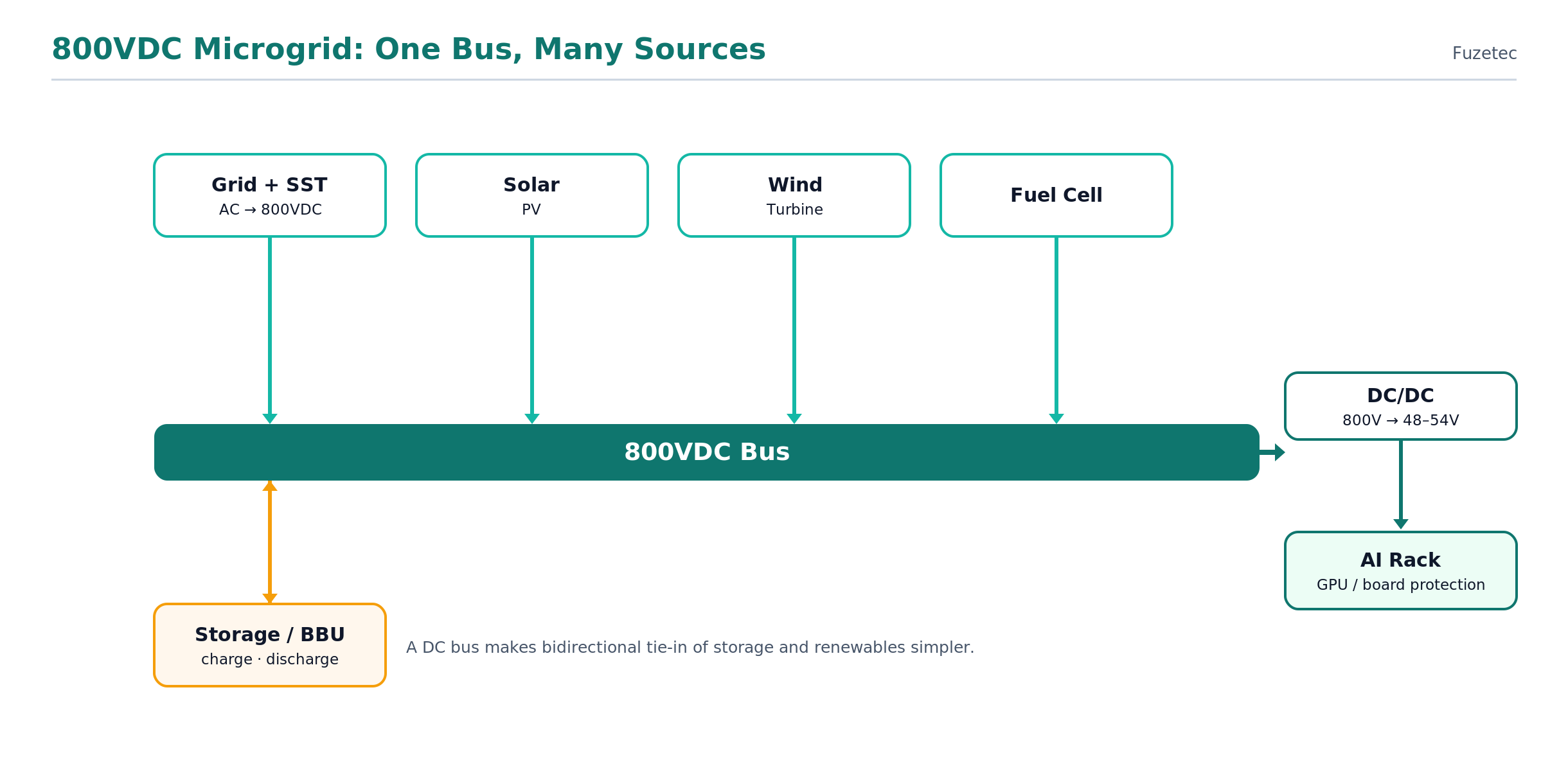
Figure 1. An 800 VDC bus integrating storage/BBU, solar, wind, and fuel cells (illustration by Fuzetec).
New Challenges High Voltage Poses to Protection Devices
The biggest difference in going from AC to DC is that the current no longer has a periodic zero crossing. An AC arc naturally extinguishes each time the current returns to zero, but a DC arc keeps burning — making fault arcs harder to interrupt and arc-flash energy higher. This makes a device’s DC breaking capacity the primary metric: a fuse or switch marked with an AC rating does not guarantee safe interruption under 800 V DC.
At the same time, the higher voltage amplifies insulation and creepage risks, so any selection must put “can it safely clear a DC fault” ahead of raw performance.
Key Points on Rated Voltage and Insulation
First, rated voltage must be read as DC, not AC RMS. Many devices’ AC ratings cannot be scaled proportionally to DC, and DC breaking ratings are often lower — you must check the DC entries in the datasheet.
Second, a varistor’s maximum continuous operating voltage (MCOV) must exceed the bus voltage with margin to avoid long-term leakage and degradation. Third, creepage and clearance distances must be redesigned to the IEC/UL levels for the higher voltage, with proper insulation coordination. These are not bonus features — they are the entry ticket for high-voltage DC.
Selection and Design Adjustments
- Fuses: switch to DC or semiconductor fuses with a proper DC breaking rating; their current-limiting behavior can cut peak let-through to 15–25% of the prospective fault current (depending on fuse class), sharply reducing arc energy — but they require selective coordination with upstream and downstream stages.
- MOV varistors: they absorb high-energy surges, but on DC beware of follow-current — with no zero crossing to help quench the arc, thermal runaway is possible, so select by DC MCOV and pair with a reliable series disconnect.
- TVS diodes: on a DC bus, choose unidirectional parts with adequate standoff voltage for fast, precise clamping of sensitive nodes.
- Active protection: solid-state circuit breakers (SSCBs — unlike the SST, which handles voltage conversion, an SSCB is dedicated to fault interruption) offer sub-millisecond DC interruption and selective coordination — an important trend for high-voltage DC, though cost, conduction loss, and thermal management must be weighed.
- Not every layer is 800 V: board-level 48–54 V, 12 V, and POL rails remain low-voltage, so existing PPTC, TVS, and eFuse devices largely carry over. What truly needs upgrading is concentrated in the high-voltage DC front end and the power input stage.
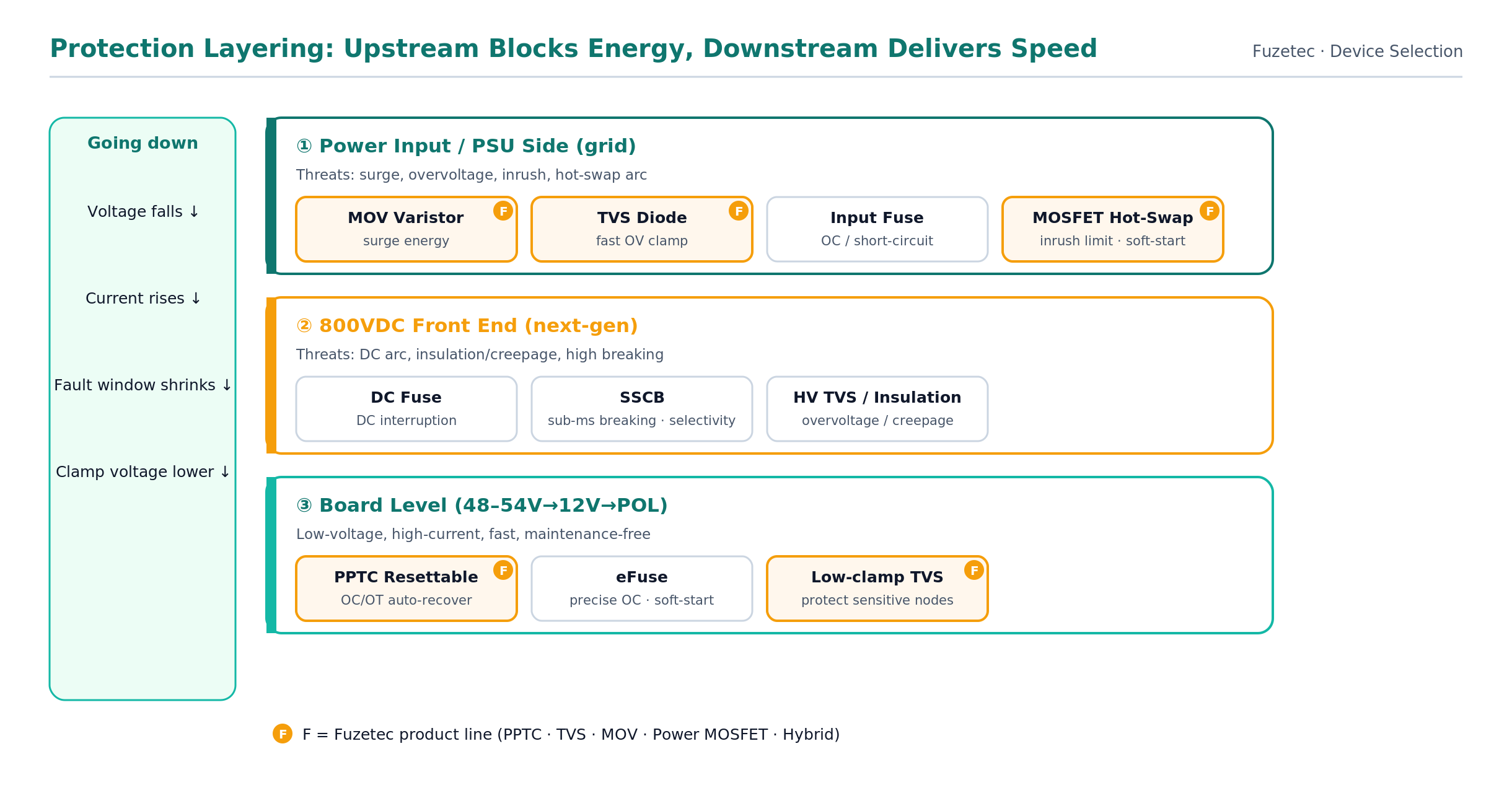
Figure 2. Protection layering and device selection; the “F” badge marks Fuzetec’s product line (illustration by Fuzetec).
Handling the Transition Period
Most data centers will go through a period where AC and DC coexist rather than switching over all at once. The pragmatic approach is to inventory each layer of the power chain and separate what must be upgraded (the high-voltage front end) from what can be reused (the low-voltage board level); reserve adequate voltage derating and insulation margin on the high-voltage segments; and confirm devices’ DC ratings and UL/IEC certifications with suppliers early, so you don’t discover a spec mismatch mid-deployment. Working layer by layer, in sequence, is the key to reducing risk.
FAQ
Q: Can existing AC fuses be used directly at 800 VDC?A: Not advisable. AC and DC interruption mechanisms differ, and an AC rating does not guarantee safe DC clearing. Move to products with an explicit DC breaking rating.
Q: Can MOVs be reused?
A: They need re-evaluation. With no zero crossing to help quench the arc, follow-current can drive an MOV into thermal runaway, so select by DC MCOV and ensure a reliable series disconnect.
Q: Does every protection device have to be replaced?
A: No. Protection on the low-voltage board side (54 V/12 V/POL) largely carries over; upgrades concentrate on the high-voltage DC distribution front end and power input stage.
Q: Is 800 V considered high voltage by regulation?
A: By name the industry calls it HVDC (high-voltage DC), but under most safety classifications (IEC: DC ≤ 1500 V) 800 V is still in the low-voltage band. The key point: it is high enough that creepage and clearance must be designed to a higher class, and you cannot reuse traditional low-voltage safety margins.
Conclusion & High-Voltage Protection Consultation
800 VDC is not simply a matter of turning up the voltage — it rewrites the premises of protection design: DC arcs don’t self-extinguish, interruption is harder, and insulation requirements rise. So the answer to “can current devices still be used” is this: the principles and device families still apply, but the high-voltage DC front end must be re-selected and given DC-specific interruption, follow-current, and insulation measures, while the low-voltage board level largely continues as-is.
Fuzetec Technology has specialized in circuit protection since 1997, with a portfolio spanning PPTC resettable fuses, TVS diodes, MOV varistors, power MOSFETs, and hybrid protection solutions, all built to AEC-Q200 and IATF 16949 standards. If you are evaluating protection-device upgrades and selection under an 800 VDC architecture, contact our engineering team — we can help inventory the DC ratings and design adjustments needed at every layer.High-voltage protection consultation & selection support: www.fuzetec.com | Tel: +886-2-8990-2113