
Is BBU / Backup Power Switchover the Riskiest Moment? Protection Design for Backup Systems
Executive Summary
In an AI data center, the battery backup unit (BBU) is the last line of defense for keeping power alive. The moment mains fails, the BBU must take over the 48–54 V DC bus within milliseconds so the GPU rack doesn’t crash from a brief interruption. The paradox is that a backup system is most likely to fail not while it is steadily supplying power, but in the instant of switchover.During switchover, inrush current, voltage transients, and reverse back-feed between sources all appear at once — mishandle any one of them and you can collapse the bus or damage components. This article explains the electrical risks during switchover and how protection devices should respond.
Electrical Risks During Backup Switchover
Backup power is a layered relay in time: decoupling capacitors handle microsecond-scale transients, supercapacitors (LICs) cover the millisecond gap, and the BBU (typically to the OCP ORv3 rack standard) carries the seconds-to-minutes holdup (typically 5–15 minutes). The real risk concentrates in the brief instant when two sources hand off.When the battery is switched onto the bus, three hazards can stack: first, the bus voltage sags during the handoff gap, and downstream circuits that cannot compensate in time trip their undervoltage protection; second, connecting the battery to large capacitors draws a heavy inrush current; third, paralleling mains and battery for an instant can cause reverse back-feed. Since BBUs are usually hot-swappable modules, insertion and removal of live contacts can also produce arcing.
Surge and Inrush Current Issues
The most underestimated of these is inrush current. The instant a battery or mains connects to the bus, it must charge a large bank of downstream bulk capacitors, and the surge current can reach several times the normal operating current — enough to momentarily collapse the bus voltage, burn connector contacts, or even break down the switching MOSFET.Switchover is also accompanied by voltage overshoot and undershoot; these transients propagate along the bus and stress voltage-sensitive downstream circuits. Hot-swap makes it harder still — every live insertion is a miniature inrush-and-arc event.
How Protection Devices Respond
- Inrush limiting and soft-start: a power MOSFET paired with a hot-swap controller provides current limiting and soft-start / precharge, keeping the power-up surge within a safe range.
- Reverse-current isolation: ORing / ideal diodes between paralleled sources block reverse back-feed, preventing the battery from feeding back into mains or into another source.
- Overvoltage clamping: TVS diodes absorb switching transients and overshoot to protect sensitive downstream nodes.
- Overcurrent and short-circuit protection: fuses provide the final interruption, while PPTC resettable fuses or eFuses provide self-recovering protection after overcurrent/overtemperature, reducing maintenance swaps.
- Timing coordination: letting supercapacitors bridge the millisecond gap first, then handing off to the BBU, effectively reduces the magnitude and steepness of the switchover stress.
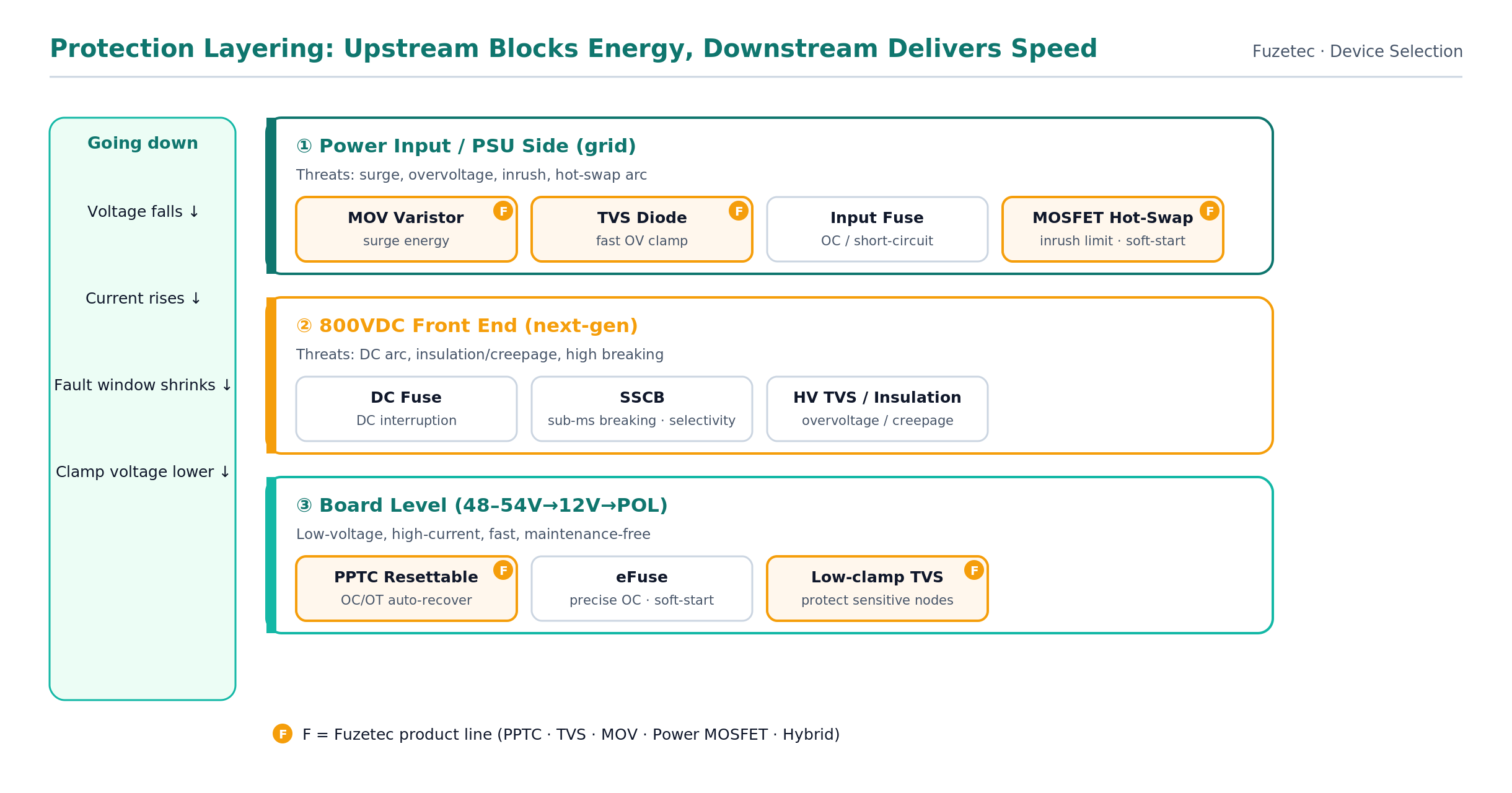
Figure. Protection layering and device selection for backup power; the “F” badge marks Fuzetec’s product line (illustration by Fuzetec).
Selection Considerations
Device selection on the backup side must satisfy both electrical and environmental conditions: the current rating must cover both continuous and peak values; breaking capacity must be enough to clear faults safely; response speed must match the switchover timing; and on-resistance must be low to control efficiency and heat.Beyond that, resettable and one-time devices should be assigned by role — nodes that must stay uninterrupted and replacement-free favor PPTC or eFuse, while critical short-circuit protection is still guarded by one-time fuses. Temperature endurance and lifetime in a battery environment, package size, and whether the part carries automotive-grade validation such as AEC-Q200 are all important criteria.
Reliability and Supply
Backup is the last line of defense, so if a protection device itself is unreliable, it becomes a new single point of failure. Beyond electrical specs, then, you must look at batch consistency, thermal-cycling lifetime, and MTBF, and ensure long-term, stable supply so the same design keeps consistent quality across years of production. Choosing a supplier with automotive- and industrial-grade validation and a stable supply chain is the invisible foundation of backup-system reliability.FAQ
Q: Why is the switchover moment the riskiest?A: Because in the brief instant two sources hand off, inrush current, voltage transients, and reverse back-feed can all occur together, plus arcing at hot-swap contacts — and any one of them getting out of control affects the bus and everything downstream.
Q: How do you tame inrush current?
A: Use a power MOSFET with a hot-swap controller for current limiting and soft-start / precharge, so capacitor charging current rises in a controlled way instead of rushing in all at once.
Q: Does a backup system need reverse-current protection?
A: Yes. When mains and battery are paralleled, ORing or ideal diodes must isolate them to prevent sources feeding back into each other, which can cause damage or malfunction.
Q: Resettable or one-time fuses on the backup side?
A: Both, by role. Nodes that value uninterrupted, replacement-free operation suit PPTC resettable fuses or eFuses; safety-critical short-circuit interruption is still guarded by one-time fuses, and the two are often used together.
Conclusion & Backup Power Consultation
The value of a backup system is that it takes over cleanly at the moment it is needed — and its most fragile point is exactly that instant of switchover. Good protection design manages the inrush current, voltage transients, reverse back-feed, and hot-swap arcing of that instant all at once, and keeps the protection devices themselves reliable and reliably supplied — because on the last line of defense, a component must never become the source of the failure.Fuzetec Technology has specialized in circuit protection since 1997, with a portfolio spanning PPTC resettable fuses, TVS diodes, MOV varistors, power MOSFETs, and hybrid protection solutions, all built to AEC-Q200 and IATF 16949 standards. If you are designing switchover protection for a BBU or data center backup power system, contact our engineering team — we can help evaluate device selection for inrush limiting, reverse-current isolation, and overcurrent protection.
Backup power protection consultation & selection support: www.fuzetec.com | Tel: +886-2-8990-2113