Table of Contents
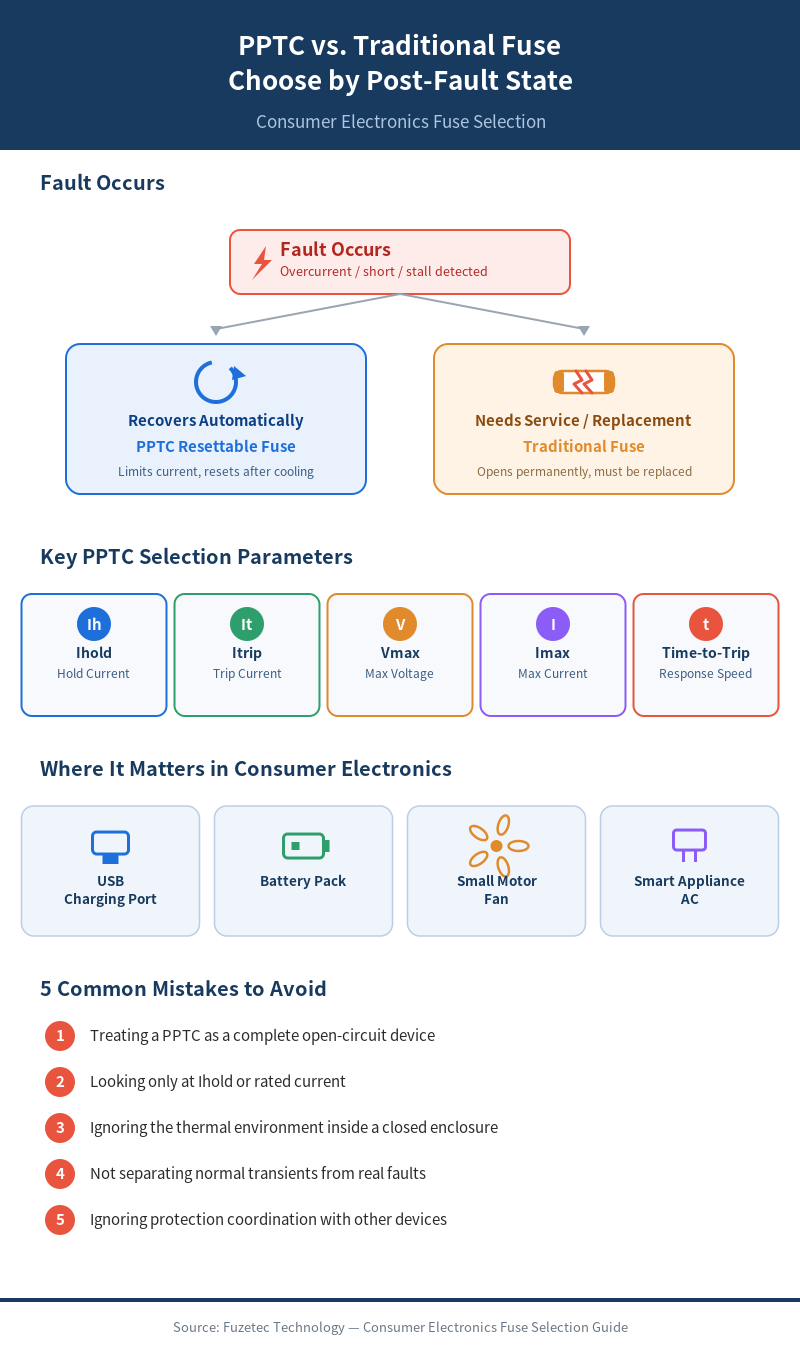
The core of consumer electronics fuse selection is not deciding whether a PPTC or a traditional fuse is “better.” It is deciding what the system should do after a fault: remain permanently disconnected for service, or limit current and recover after the fault is removed. A traditional fuse is generally a one-time disconnect device. A PPTC resettable fuse increases resistance as overcurrent raises its temperature, limiting current and returning to a low-resistance state after the fault is removed and the device cools.
For a handheld device, USB peripheral, smart appliance control board, or battery-powered product, this decision directly affects the BOM, service model, customer-return risk, and validation plan. Many designs stall not because engineers misunderstand fuses, but because rated current is treated as the only selection criterion.
Suppose hardware engineer Mina finds a problem during EVT in March. The prototype works normally in the lab, but the entire device fails when a user inserts an external accessory incorrectly, and the enclosure must be opened to replace the protection device. Her first reaction is to increase the fuse current rating. After the team reviews the fault scenario, however, the real question becomes clear: should this incorrect connection permanently shut the product down, or should it recover after the user removes the accessory? That is the starting point for PPTC vs. fuse selection.
For a general overview, refer to Fuzetec’s comparison of traditional fuses and PPTC resettable fuses. This article focuses more specifically on the decision process for consumer electronics and ODM/OEM hardware design.
If you already know the operating voltage, normal operating current, possible fault current, and ambient temperature, you can first review Fuzetec’s PPTC resettable fuse product categories, then use the tables in this article to confirm whether your selection inputs are complete.
The conclusion cannot simply be that a PPTC is more convenient. Fuzetec’s PPTC fuse overview explains that a PPTC remains at low resistance during normal operation, increases resistance as abnormal overcurrent generates heat, and can recover after the fault is removed and the device cools. This behavior fits some recoverable faults, but it does not mean every circuit should use a PPTC.
A common challenge in consumer electronics is that a single product may require different protection strategies. The AC input, battery path, USB port, small motor, and low-voltage digital rail face different fault conditions and may require different service responses.
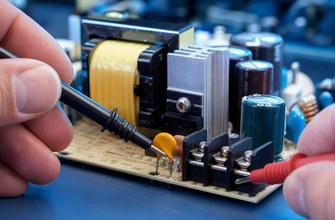
In consumer electronics, traditional fuses are often part of a protection strategy that requires a definite open circuit. Their behavior is unambiguous: after the fuse opens, the circuit does not recover, forcing the service team to investigate the cause.
That same behavior can also be a limitation. In a sealed product, a device whose protection component is not user-replaceable, or a product with high field-service costs, a one-time fuse can turn a minor recoverable fault into a return or repair.
Suppose Jason is responsible for a desktop smart device. The first design uses a traditional fuse to protect an external accessory port, and the BOM cost appears reasonable. During preproduction user testing, a nonstandard accessory causes overcurrent, the fuse opens, and the product must be returned to the factory. The team does not simply increase the current rating. Instead, it redefines the port’s fault strategy: should a temporary user-caused fault permanently shut down the product? This question comes before the component price.
This behavior has two direct implications for consumer electronics.
First, a PPTC limits current; it does not create the permanent open circuit of a traditional fuse. Bel Fuse also notes that a tripped PTC does not necessarily isolate the load completely, because a high-resistance leakage path may remain. Therefore, when the design requires full disconnection during a fault, a PPTC should not replace a traditional fuse solely because it can reset.
Second, PPTC behavior depends on temperature, initial resistance, and installation conditions. Fuzetec’s PPTC fundamentals explain that the region between hold current (Ihold) and trip current (Itrip) is not fully deterministic. Actual behavior is affected by initial resistance, ambient temperature, and mounting conditions.
The DigiKey TechForum PPTC FAQ describes the same behavior concisely: low resistance in normal operation, a transition to high resistance as overcurrent generates heat, and a return toward the initial resistance after the overcurrent condition is removed. This makes PPTCs useful for recoverable protection, but the design must still be tested under actual fault conditions.
To begin screening by parameters, review Fuzetec’s PPTC selection guide and prepare the operating voltage, normal load current, fault current, required trip time, thermal derating, and package conditions.
The purpose of this table is to prevent teams from treating either a PPTC or a traditional fuse as the universal solution. Because this article focuses on passive protection-device selection, begin with how the system should recover after a fault, then evaluate voltage, current, temperature, and package conditions.
USB and charging ports may also face ESD, transient voltage, reverse polarity, or protocol-related issues. Overcurrent is not the only risk. If the design also requires overvoltage or transient protection, separately evaluate architectures such as MOV varistors, TVS diodes, or hybrid protection from the Overvoltage Protection product category, then verify the design through datasheets and system testing.
Fuzetec’s product categories include Battery Strap devices as a starting point for battery-pack and interconnect protection applications. Suitability must still be confirmed against the battery-pack design, fault current, thermal conditions, and product safety requirements.
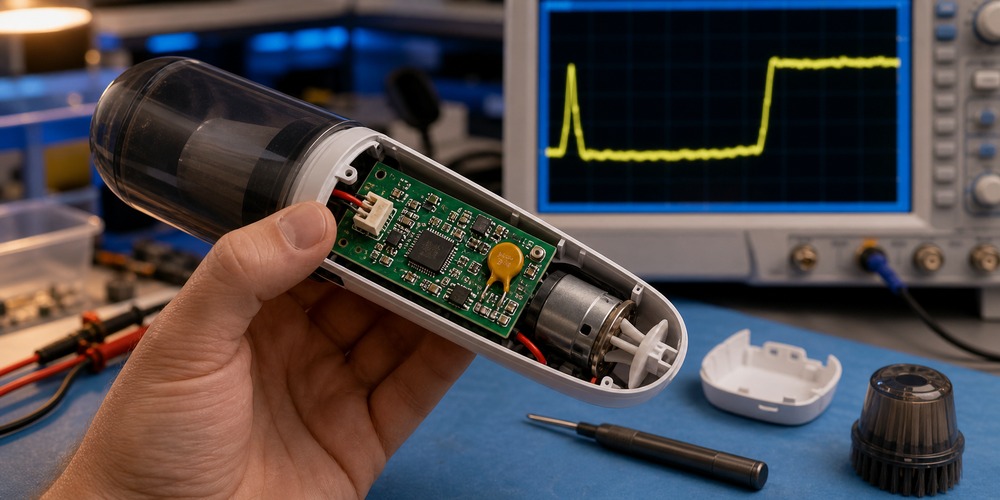
Suppose Ryan is designing a handheld cleaning device. The motor draws a brief current above steady-state current during startup, but when the user holds the brush head and causes a stall, current remains in an abnormal range. Ryan’s team separates the oscilloscope waveform into startup, steady-state, and stall intervals, then evaluates Ihold, Itrip, and time-to-trip. This is more useful than asking only, “What is the motor current?”
A PPTC may be a candidate for overcurrent protection on some low-voltage or downstream paths, but it should not be described as a replacement for every fuse. For primary-side or safety-critical paths, verify the design against product standards, test conditions, and component certification documents.
A small package does not complete the selection process. Resistance, voltage drop, heat generation, thermal derating, and fault conditions still need to be verified. Prototype testing is especially important inside sealed enclosures or near heat-generating components.
Selection CTA: If your BOM review is stalled on “PPTC or traditional fuse,” organize the eight items above first, then contact Fuzetec to confirm the appropriate product category and required application data.
The next step is not immediate part-number selection. First document operating voltage, normal current, transient current, fault current, time-to-trip, thermal derating, package conditions, and the service strategy. Once these inputs are complete, review the PPTC selection guide, search the PPTC resettable fuse product categories, or contact Fuzetec to confirm the appropriate product direction.
For a handheld device, USB peripheral, smart appliance control board, or battery-powered product, this decision directly affects the BOM, service model, customer-return risk, and validation plan. Many designs stall not because engineers misunderstand fuses, but because rated current is treated as the only selection criterion.
Suppose hardware engineer Mina finds a problem during EVT in March. The prototype works normally in the lab, but the entire device fails when a user inserts an external accessory incorrectly, and the enclosure must be opened to replace the protection device. Her first reaction is to increase the fuse current rating. After the team reviews the fault scenario, however, the real question becomes clear: should this incorrect connection permanently shut the product down, or should it recover after the user removes the accessory? That is the starting point for PPTC vs. fuse selection.
For a general overview, refer to Fuzetec’s comparison of traditional fuses and PPTC resettable fuses. This article focuses more specifically on the decision process for consumer electronics and ODM/OEM hardware design.
If you already know the operating voltage, normal operating current, possible fault current, and ambient temperature, you can first review Fuzetec’s PPTC resettable fuse product categories, then use the tables in this article to confirm whether your selection inputs are complete.
Key Takeaways
- Start consumer electronics fuse selection by defining the required post-fault state: permanent shutdown, current limiting with recovery, or control by a protection IC.
- A traditional fuse melts and opens the circuit during overcurrent and usually must be replaced. A PPTC resettable fuse limits current by increasing resistance, then recovers after the fault is removed and the device cools.
- A PPTC is not a complete open-circuit device. Confirm whether a high-resistance current path is acceptable while the fault remains present.
- Ihold, Itrip, Vmax, Imax, time-to-trip, thermal derating, and package heat dissipation all affect actual performance in consumer electronics.
- Final selection must still be verified against the datasheet, thermal derating curves, fault testing, and applicable product safety requirements.
Direct Answer: Start with the Required Post-Fault State
Begin consumer electronics fuse selection by asking three questions:- Could the fault be caused by user misconnection, a temporary short circuit, a stalled motor, or another removable condition?
- After the fault is removed, may the product recover automatically?
- Does this protection location require a definite circuit interruption that triggers service or replacement?
The conclusion cannot simply be that a PPTC is more convenient. Fuzetec’s PPTC fuse overview explains that a PPTC remains at low resistance during normal operation, increases resistance as abnormal overcurrent generates heat, and can recover after the fault is removed and the device cools. This behavior fits some recoverable faults, but it does not mean every circuit should use a PPTC.
A common challenge in consumer electronics is that a single product may require different protection strategies. The AC input, battery path, USB port, small motor, and low-voltage digital rail face different fault conditions and may require different service responses.
How Does a Traditional Fuse Protect a Circuit? Benefits and Limits of One-Time Disconnection
The protection logic of a traditional fuse is straightforward. When overcurrent heats the fuse element until it melts, the circuit opens. Fuzetec’s comparison article identifies this as a primary difference between traditional fuses and PPTCs: a traditional fuse must be replaced after it opens, while a PPTC returns to a low-resistance state after the fault is removed and the device cools.When Is a Traditional Fuse the Better Fit?
A traditional fuse is appropriate where the design requires a clear shutdown after a fault. Such locations may require inspection by service personnel and may also be tied to safety standards, system safety strategy, or product liability considerations.In consumer electronics, traditional fuses are often part of a protection strategy that requires a definite open circuit. Their behavior is unambiguous: after the fuse opens, the circuit does not recover, forcing the service team to investigate the cause.
That same behavior can also be a limitation. In a sealed product, a device whose protection component is not user-replaceable, or a product with high field-service costs, a one-time fuse can turn a minor recoverable fault into a return or repair.
Component Cost Alone Misses the Service Model
Purchasing teams may view a traditional fuse as the lower-cost option. Hardware engineers, however, must include the recovery method after the fuse opens in the design evaluation.Suppose Jason is responsible for a desktop smart device. The first design uses a traditional fuse to protect an external accessory port, and the BOM cost appears reasonable. During preproduction user testing, a nonstandard accessory causes overcurrent, the fuse opens, and the product must be returned to the factory. The team does not simply increase the current rating. Instead, it redefines the port’s fault strategy: should a temporary user-caused fault permanently shut down the product? This question comes before the component price.
How Does a PPTC Resettable Fuse Protect a Circuit? Benefits and Limits of Current Limiting and Recovery
The key behavior of a PPTC resettable fuse is that material resistance rises with temperature. According to Fuzetec’s PPTC fundamentals, conductive particles are dispersed within a polymer structure. Under normal conditions they form conductive paths. When fault current heats the material, the particles separate and resistance increases sharply.This behavior has two direct implications for consumer electronics.
First, a PPTC limits current; it does not create the permanent open circuit of a traditional fuse. Bel Fuse also notes that a tripped PTC does not necessarily isolate the load completely, because a high-resistance leakage path may remain. Therefore, when the design requires full disconnection during a fault, a PPTC should not replace a traditional fuse solely because it can reset.
Second, PPTC behavior depends on temperature, initial resistance, and installation conditions. Fuzetec’s PPTC fundamentals explain that the region between hold current (Ihold) and trip current (Itrip) is not fully deterministic. Actual behavior is affected by initial resistance, ambient temperature, and mounting conditions.
Which Consumer Electronics Applications May Benefit from a PPTC?
PPTCs are worth evaluating for recoverable faults, such as a shorted external peripheral, an abnormal charging path, a temporary overload inside a portable product, a small motor stall that can be cleared, or equipment that is difficult to open for replacement of a protection component.The DigiKey TechForum PPTC FAQ describes the same behavior concisely: low resistance in normal operation, a transition to high resistance as overcurrent generates heat, and a return toward the initial resistance after the overcurrent condition is removed. This makes PPTCs useful for recoverable protection, but the design must still be tested under actual fault conditions.
To begin screening by parameters, review Fuzetec’s PPTC selection guide and prepare the operating voltage, normal load current, fault current, required trip time, thermal derating, and package conditions.
PPTC vs. Traditional Fuse Comparison: What Matters in Consumer Electronics Design?
The following table is not intended to provide one universal answer. It helps hardware teams align on the key decision factors during design review.| Decision Factor | Traditional Fuse | PPTC Resettable Fuse | Consumer Electronics Selection Note |
| Post-fault state | Usually requires replacement after opening | Returns to low resistance after the fault is removed and the device cools | May the product recover automatically? |
| Protection behavior | Opens the circuit | Increases resistance to limit current | Must the load be fully isolated? |
| Service model | Requires component replacement or service | Supports recovery after a removable fault | Pay special attention to sealed or hard-to-open products |
| Selection parameters | Rated current, voltage, time-current curve, interrupting rating | Ihold, Itrip, Vmax, Imax, time-to-trip, thermal derating | Do not compare only one current value |
| Temperature effect | Must still be verified for the specification and application | Temperature affects hold and trip behavior | Test near heat sources and inside closed enclosures |
| Typical direction | Paths requiring clear shutdown and service | Paths with removable faults where replacement should be minimized | Decide by fault scenario, not component name |
The purpose of this table is to prevent teams from treating either a PPTC or a traditional fuse as the universal solution. Because this article focuses on passive protection-device selection, begin with how the system should recover after a fault, then evaluate voltage, current, temperature, and package conditions.
How Should Consumer Electronics Designs Choose Between a PPTC and a Traditional Fuse?
Consumer electronics is not a single application category. The following scenarios provide an initial decision framework.USB, Charging Ports, and External Peripherals
USB ports, charging ports, and external peripherals are exposed to frequent insertion and removal, incorrect insertion, and cables or accessories of inconsistent quality. Some of these faults are temporary. If the system should recover after the fault is removed, a PPTC resettable fuse may be a candidate.USB and charging ports may also face ESD, transient voltage, reverse polarity, or protocol-related issues. Overcurrent is not the only risk. If the design also requires overvoltage or transient protection, separately evaluate architectures such as MOV varistors, TVS diodes, or hybrid protection from the Overvoltage Protection product category, then verify the design through datasheets and system testing.
Rechargeable Battery Packs and Handheld Products
Battery-powered products often prioritize space, temperature, and service accessibility. If the product is difficult to disassemble, an opened protection component may require return of the entire unit. In that case, evaluate whether PPTC resettable protection aligns with the system safety strategy.Fuzetec’s product categories include Battery Strap devices as a starting point for battery-pack and interconnect protection applications. Suitability must still be confirmed against the battery-pack design, fault current, thermal conditions, and product safety requirements.
Small Motors, Fans, and Moving Mechanisms
For small-motor products, distinguish startup current from stall current. Startup current may be normal, while stall current may represent a fault requiring protection. If the two are not separated, a PPTC may nuisance-trip during normal startup or may not respond as required during a stall.Suppose Ryan is designing a handheld cleaning device. The motor draws a brief current above steady-state current during startup, but when the user holds the brush head and causes a stall, current remains in an abnormal range. Ryan’s team separates the oscilloscope waveform into startup, steady-state, and stall intervals, then evaluates Ihold, Itrip, and time-to-trip. This is more useful than asking only, “What is the motor current?”
Smart Appliances and AC Inputs
When the protection location is near the AC line or a high-energy input, selection cannot rely only on low-voltage DC consumer-electronics logic. The design may require a traditional fuse, MOV varistor, TVS diode, or other coordinated protection and may also involve safety and fail-open requirements.A PPTC may be a candidate for overcurrent protection on some low-voltage or downstream paths, but it should not be described as a replacement for every fuse. For primary-side or safety-critical paths, verify the design against product standards, test conditions, and component certification documents.
Space-Constrained PCBs and Modular Designs
Consumer electronics PCBs are often size-constrained. When surface-mount or compact packages are required, the SMD PPTC and Chip & Disc PPTC product categories can provide a starting point for package selection.A small package does not complete the selection process. Resistance, voltage drop, heat generation, thermal derating, and fault conditions still need to be verified. Prototype testing is especially important inside sealed enclosures or near heat-generating components.
Consumer Electronics Fuse Selection Process: Eight Items to Confirm Before the BOM
Fuzetec’s PPTC selection guide covers operating voltage, hold current, trip current, maximum voltage, maximum current, trip time, thermal derating, environmental conditions, and safety requirements. For consumer electronics, these inputs can be organized into eight questions:- Operating and maximum possible voltage: What is the highest voltage at the protection location? During a fault, does the voltage across the device remain within its rating?
- Normal load current: Have standby, typical load, full load, and short-duration peak current been recorded separately?
- Transient current: Do startup, charging, motor starting, or peripheral insertion create brief high-current events?
- Fault current: During a short circuit, overload, stall, or abnormal accessory connection, how much fault current can the source deliver?
- Protection operating time: How long can downstream components tolerate the fault? Does the PPTC time-to-trip or traditional fuse curve meet that requirement?
- Maximum fault capability: Are the PPTC Imax and Vmax, or the traditional fuse interrupting rating, sufficient?
- Thermal environment and derating: Have maximum ambient temperature, internal heat sources, PCB copper, and heat dissipation been included?
- Service and compliance strategy: May the product recover automatically? Must service personnel intervene? Are there safety, market, or customer requirements?
Selection CTA: If your BOM review is stalled on “PPTC or traditional fuse,” organize the eight items above first, then contact Fuzetec to confirm the appropriate product category and required application data.
Common Mistakes: Which Decisions Most Often Undermine Consumer Electronics Protection?
Mistake 1: Treating a PPTC as a Complete Open-Circuit Device
A PPTC’s core behavior is to increase resistance and limit current, not to melt open permanently like a traditional fuse. If the system must completely isolate the faulted load, re-evaluate the protection architecture.Mistake 2: Looking Only at Ihold or Rated Current
Hold current (Ihold) is only a starting point. PPTC selection must also consider trip current (Itrip), Vmax, Imax, time-to-trip, initial resistance, thermal derating, and actual mounting conditions. A traditional fuse also cannot be selected by current rating alone; voltage, time-current curve, and interrupting rating matter as well.Mistake 3: Ignoring the Thermal Environment Inside a Closed Enclosure
Consumer electronics designs often prioritize miniaturization. When a PPTC is near a battery, charging IC, MOSFET, motor driver, or heat sink, its actual temperature may differ significantly from an open test board. Higher ambient temperature can reduce available hold-current capability, so thermal derating must be included.Mistake 4: Failing to Separate Normal Transients from Real Faults
Startup, hot-plugging, initial charging, and motor starting can all produce short-duration current changes. These events are not necessarily faults. If the protection device operates during a normal transient, the product may appear unstable; if it does not operate during a true fault, the protection loses its purpose.Mistake 5: Ignoring Protection Coordination
Consumer electronics faults are not limited to overcurrent. ESD, surges, reverse polarity, overvoltage, battery abnormalities, and firmware control may occur together. A PPTC or traditional fuse addresses only part of overcurrent protection and must be coordinated with other protection devices, control ICs, and system-level strategies.FAQ: Common PPTC vs. Fuse Questions from Engineers
Can a PPTC Directly Replace a Traditional Fuse?
Do not frame the decision as a direct replacement. PPTC resettable fuses and traditional fuses create different post-fault states. If the original design requires a permanent interruption after the fuse opens, a PPTC’s high-resistance current limiting and resettable behavior may not meet the requirement. A PPTC becomes worth further evaluation when the fault is removable and the product is difficult to service.Do Consumer Electronics Products Always Need Resettable Fuses?
No. A single consumer electronics product may use multiple protection strategies. Low-voltage locations with recoverable, user-caused temporary faults may be suitable for PPTC evaluation. Paths requiring a definite fail-open state, service inspection, or safety compliance may be better suited to a traditional fuse or another protection method.Does the Circuit Fully Open After a PPTC Trips?
It should not be described that way. According to Fuzetec’s PPTC technical article, a PPTC increases resistance to limit current as overcurrent raises its temperature, then returns to a low-resistance state after the fault is removed and it cools. This is not the permanent open-circuit behavior of a traditional fuse.What Do Ihold and Itrip Mean in Device Selection?
Hold current (Ihold) is the maximum current the device can carry without tripping under specified conditions. Trip current (Itrip) is the minimum current required to place the device into its tripped state. Fuzetec’s PPTC fundamentals also note that behavior in the region between Ihold and Itrip can be affected by initial resistance, ambient temperature, and mounting conditions.Why Does High Temperature Affect PPTC Selection?
PPTC operation is temperature-dependent. At higher ambient temperatures or near a heat source, actual hold capability and trip behavior may differ from room-temperature test results. Because consumer electronics often use sealed enclosures and compact PCBs, thermal derating and in-system testing are important.Is a PPTC Alone Enough for USB-C, Charging-Port, or Battery Products?
Not necessarily. A PPTC can be evaluated for overcurrent protection, but USB-C, charging-port, and battery products may also involve protocol behavior, reverse polarity, ESD, overvoltage, thermal management, and safety requirements. Protection should be coordinated based on the full system risk.Conclusion: Start with the Fault Strategy, Not the Component Name
The first step in consumer electronics fuse selection is to define the state the product should enter after a fault. If the fault must create a permanent interruption and trigger service, a traditional fuse or another fail-open strategy may better match the goal. If the fault is removable, the product is difficult to service, and the system permits current limiting followed by recovery, a PPTC resettable fuse is worth evaluating.The next step is not immediate part-number selection. First document operating voltage, normal current, transient current, fault current, time-to-trip, thermal derating, package conditions, and the service strategy. Once these inputs are complete, review the PPTC selection guide, search the PPTC resettable fuse product categories, or contact Fuzetec to confirm the appropriate product direction.
Sources
- Fuzetec, Traditional Fuse vs. PPTC Resettable Fuse: A Comprehensive Comparison
- Fuzetec, PPTC Fuse Explained: A Guide to Automatically Resettable Overcurrent Protection
- Fuzetec, PPTC Fundamentals
- Fuzetec, A Comprehensive Guide to Selecting PPTC Resettable Fuses
- DigiKey TechForum, How PPTCs Prevent Overcurrent Through Automatic Reset and Typical Applications
Tag