Table of Contents
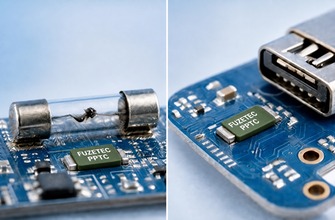
A resettable fuse is an overcurrent protection component that automatically restores normal circuit operation once a fault clears and the device cools, rather than requiring physical replacement like a traditional one-time fuse. The two most common resettable fuse technologies are polymer PTC (PPTC), which uses a conductive polymer matrix well suited to compact, low-current applications, and ceramic PTC (CPTC), which uses a ceramic material better suited to higher-current applications with excellent long-term resistance stability. Choosing between them, or between a resettable fuse and a traditional fuse, depends on the application's current level, required response time, need for automatic recovery, and relevant safety certifications.
A resettable fuse is a positive temperature coefficient (PTC) device: at normal operating temperature it presents a low, stable resistance, but when current exceeds a threshold, resistive heating drives the device into a high-resistance state that limits current to a safe level. Once the fault is removed and the device cools, resistance drops back down and the circuit resumes normal operation automatically, without requiring a technician to physically replace a blown component.
Ceramic PTC devices generally offer better long-term resistance stability after repeated current shocks, while PPTC devices offer faster response and a smaller footprint — making PPTC the more common choice in compact consumer electronics and CPTC more common in higher-current industrial or appliance circuits.
Traditional fuses remain preferable in applications where a precise, one-time, unambiguous circuit interruption is required for safety compliance, while resettable fuses are generally favored wherever the added convenience of automatic recovery outweighs the need for a hard, permanent break. Many product designs actually use both technologies together, layering a traditional fuse as a final catastrophic-fault backstop behind a resettable device that handles routine, recoverable overcurrent events.
Bimetallic thermal circuit breakers are another resettable overcurrent protection option, using a bimetallic strip that physically bends and opens a mechanical contact when heated by excess current, then resets either automatically or manually once cooled. Compared to PTC-based resettable fuses, thermal circuit breakers typically handle higher currents and offer a true open-circuit condition, but are larger, more expensive, and mechanically more complex than a solid-state PTC device, making them better suited to equipment where physical size and cost are secondary to absolute circuit isolation.
Buyers sourcing resettable fuses for regulated markets, particularly automotive, medical, or telecommunications equipment, should confirm which specific certifications the manufacturer holds for the exact part number being specified, since qualification can vary across a single manufacturer's broader product catalog. Requesting the actual certification documentation and test reports, rather than relying on general marketing claims, is the most reliable way to confirm a part is suitable for a regulated end application.
A: PPTC uses a polymer matrix and suits compact, lower-current applications, while ceramic PTC handles higher current with more stable long-term resistance.
Q: Can a resettable fuse replace a traditional fuse in every application?
A: Not always — applications requiring a precise, permanent circuit break for safety compliance may still require a traditional fuse.
Q: How many times can a resettable fuse trip before it wears out?
A: Most are rated for many trip-and-reset cycles, though resistance can drift slightly after repeated high-energy trips, especially with PPTC.
Q: Are resettable fuses suitable for automotive applications?
A: Yes — AEC-Q200 qualified PPTC devices and thermal circuit breakers are both commonly used in automotive wiring and electronics.
Q: Which resettable fuse type is best for smartphones?
A: PPTC in a compact surface-mount or chip format is the standard choice due to space constraints and fast response needs.
Q: Do resettable fuses fully open the circuit when tripped?
A: PTC-based resettable fuses limit current to a small leakage level rather than fully opening the circuit like a thermal breaker or traditional fuse.
Q: What certifications should I check before selecting a resettable fuse?
A: Confirm relevant UL or IEC safety listings, and AEC-Q200 for automotive use, based on your target market's requirements.
Q: Is a thermal circuit breaker better than a PTC resettable fuse?
A: Thermal breakers offer a true mechanical open circuit and higher current handling, but are larger and more expensive than solid-state PTC devices.
Q: Does a resettable fuse cost more than a traditional fuse?
A: Unit cost can be higher, but the elimination of replacement labor and downtime often offsets this over the product's service life.
Q: Can resettable fuses be used in medical devices?
A: Yes, provided the specific part carries certifications relevant to medical equipment safety standards for the target market. Choosing the right resettable fuse comes down to matching the device's current handling, response speed, and footprint to the specific circuit, while confirming the certifications required for the target application and market. PPTC devices remain the go-to choice for compact, low-to-moderate current electronics, ceramic PTC suits higher-current applications needing stable long-term performance, and thermal circuit breakers serve heavier-duty equipment requiring a true mechanical open circuit. A careful review of hold current, trip current, voltage rating, and expected fault frequency ensures the selected device performs reliably across the full service life of the product.
For engineers weighing these tradeoffs across a new product design, the most reliable approach is to prototype with the target device early, validate trip and reset behavior under realistic thermal and electrical conditions, and confirm certification coverage before finalizing the bill of materials — rather than treating resettable fuse selection as an afterthought late in the design cycle. This upfront diligence typically saves significant redesign cost later, since overcurrent protection failures discovered during compliance testing or field deployment are far more expensive to fix than issues caught during initial component selection.
- Protects circuits from overcurrent and overtemperature conditions without permanent damage to the component itself
- Available in polymer (PPTC) and ceramic (CPTC) material technologies with different performance tradeoffs
- Commonly used anywhere overcurrent faults may recur occasionally during normal product use
| Characteristic | Polymer PTC (PPTC) | Ceramic PTC (CPTC) |
| Typical current range | Low to moderate current applications | Higher current applications |
| Response speed | Fast, small thermal mass enables quick recovery | Generally slower response than PPTC |
| Resistance after cycling | Resistance can increase gradually after repeated trips | Resistance change after cycling is typically minimal |
| Cost and manufacturability | Widely available, cost-effective for small form factors | Simple construction, relatively low cost per unit |
| Size | Very compact, including SMD chip formats | Often larger, better suited to bulkier assemblies |
Normal Conduction State
Under normal operating conditions, both PPTC and ceramic PTC devices maintain a low, stable resistance that allows current to pass through with minimal voltage drop or heat generation, effectively acting as a low-value series resistor that has little impact on circuit performance.Trip Response
When current rises above the device's rated threshold, resistive heating raises the internal temperature past a critical transition point. In PPTC devices this causes the polymer matrix to expand and break conductive particle chains; in ceramic PTC devices, the crystalline structure of the ceramic material undergoes a similar sharp resistance increase at its Curie temperature. In both cases, the result is a dramatic rise in resistance that limits current to a safe residual level rather than allowing the fault to continue unchecked.Automatic Recovery
Once the overcurrent condition is removed and the device is allowed to cool below its transition temperature, both PPTC and ceramic PTC devices return to their low-resistance state and resume normal current-carrying capability without any manual intervention, which is the defining characteristic that separates resettable fuses from traditional fuses.| Factor | Resettable Fuse (PTC) | Traditional Fuse |
| Recovery after fault | Automatic once fault clears and device cools | Requires physical replacement |
| Suitable fault frequency | Occasional or recurring overcurrent events | Rare, one-time catastrophic faults |
| Field maintenance | No technician visit required | May require service call or part replacement |
| Precision of trip point | Broader trip curve, current-limiting behavior | Sharp, well-defined blow point |
| Application | Typical Technology | Reason |
| Smartphones and portable electronics | PPTC (SMD chip) | Extremely compact footprint required |
| USB and charging ports | PPTC | Fast response protects sensitive downstream circuitry |
| Household appliances and motors | Ceramic PTC or thermal breaker | Higher current handling required |
| Automotive wiring harnesses | PPTC (AEC-Q200 qualified) or thermal breaker | Needs to withstand repeated field fault events |
| Power tools and industrial equipment | Thermal circuit breaker or ceramic PTC | Higher current, robust mechanical environment |
- Determine the circuit's normal operating current and apply appropriate design margin to the hold current rating
- Identify maximum fault current and voltage the device must safely interrupt
- Decide between PPTC and ceramic PTC based on current level, response speed, and footprint requirements
- Confirm ambient operating temperature range and apply the manufacturer's derating curve to hold and trip current
- Verify required safety certifications (UL, IEC, AEC-Q200) for the target application and market
- Evaluate expected fault frequency to confirm the device's cycling life is adequate for the application
- Hold current (Ihold): maximum current carried continuously without tripping
- Trip current (Itrip): minimum current that causes the device to transition to high resistance
- Maximum voltage (Vmax): highest voltage the device can safely interrupt
- Maximum fault current (Imax): highest fault current the device can safely withstand without failure
- Time-to-trip: how quickly the device responds at a given overcurrent level
Surface Mount (SMD) Formats
Surface mount resettable fuses are designed for automated assembly onto printed circuit boards and dominate compact consumer electronics applications where board space is at a premium and manual assembly is not practical at production volumes.Radial Leaded and Through-Hole Formats
Radial leaded resettable fuses, more commonly found among ceramic PTC and thermal breaker products, use wire leads suited to hand assembly or higher-power applications where the larger physical size accommodates greater heat dissipation and current handling.Panel-Mount Thermal Circuit Breakers
For equipment requiring an operator-visible or manually resettable protection device, panel-mount thermal circuit breakers provide a physical switch-like reset mechanism, which is useful in industrial equipment where an operator needs clear visual confirmation that a fault has occurred and been cleared before resuming operation.| Standard | Relevance |
| UL 60950 / UL 62368 | Safety standard for IT and audio/video equipment covering overcurrent protection components |
| IEC 60127 | International standard for miniature fuses, referenced for electrical rating verification |
| AEC-Q200 | Automotive-grade passive component qualification standard |
| UL 1434 | Standard specifically covering thermal protectors, relevant to some resettable fuse and breaker types |
Ceramic PTC devices are generally simpler to manufacture and can offer a lower unit cost at higher current ratings, while PPTC devices, despite a typically higher unit cost at comparable ratings, often reduce overall system cost by enabling a smaller board footprint and fewer supporting components. Buyers evaluating total cost of ownership should weigh unit price against board space savings, assembly complexity, and expected field failure or replacement rates rather than comparing component price alone. Working with a supplier that can provide consistent lead times across both PPTC and ceramic PTC product lines also simplifies sourcing for companies that use both technologies across different product families.
- Selecting a PPTC device for a high-current application better suited to ceramic PTC or a thermal breaker
- Ignoring temperature derating and specifying hold current based on room-temperature datasheet values alone
- Assuming resettable fuses are a drop-in replacement for traditional fuses in every safety-critical application
- Overlooking required certifications (UL, AEC-Q200) for the specific target market or industry
- Not accounting for gradual resistance drift after repeated trip cycles in high-fault-frequency applications
A: PPTC uses a polymer matrix and suits compact, lower-current applications, while ceramic PTC handles higher current with more stable long-term resistance.
Q: Can a resettable fuse replace a traditional fuse in every application?
A: Not always — applications requiring a precise, permanent circuit break for safety compliance may still require a traditional fuse.
Q: How many times can a resettable fuse trip before it wears out?
A: Most are rated for many trip-and-reset cycles, though resistance can drift slightly after repeated high-energy trips, especially with PPTC.
Q: Are resettable fuses suitable for automotive applications?
A: Yes — AEC-Q200 qualified PPTC devices and thermal circuit breakers are both commonly used in automotive wiring and electronics.
Q: Which resettable fuse type is best for smartphones?
A: PPTC in a compact surface-mount or chip format is the standard choice due to space constraints and fast response needs.
Q: Do resettable fuses fully open the circuit when tripped?
A: PTC-based resettable fuses limit current to a small leakage level rather than fully opening the circuit like a thermal breaker or traditional fuse.
Q: What certifications should I check before selecting a resettable fuse?
A: Confirm relevant UL or IEC safety listings, and AEC-Q200 for automotive use, based on your target market's requirements.
Q: Is a thermal circuit breaker better than a PTC resettable fuse?
A: Thermal breakers offer a true mechanical open circuit and higher current handling, but are larger and more expensive than solid-state PTC devices.
Q: Does a resettable fuse cost more than a traditional fuse?
A: Unit cost can be higher, but the elimination of replacement labor and downtime often offsets this over the product's service life.
Q: Can resettable fuses be used in medical devices?
A: Yes, provided the specific part carries certifications relevant to medical equipment safety standards for the target market. Choosing the right resettable fuse comes down to matching the device's current handling, response speed, and footprint to the specific circuit, while confirming the certifications required for the target application and market. PPTC devices remain the go-to choice for compact, low-to-moderate current electronics, ceramic PTC suits higher-current applications needing stable long-term performance, and thermal circuit breakers serve heavier-duty equipment requiring a true mechanical open circuit. A careful review of hold current, trip current, voltage rating, and expected fault frequency ensures the selected device performs reliably across the full service life of the product.
For engineers weighing these tradeoffs across a new product design, the most reliable approach is to prototype with the target device early, validate trip and reset behavior under realistic thermal and electrical conditions, and confirm certification coverage before finalizing the bill of materials — rather than treating resettable fuse selection as an afterthought late in the design cycle. This upfront diligence typically saves significant redesign cost later, since overcurrent protection failures discovered during compliance testing or field deployment are far more expensive to fix than issues caught during initial component selection.
Tag