What Is a PPTC Fuse? The Self-Resetting Component Behind Modern Overcurrent Protection
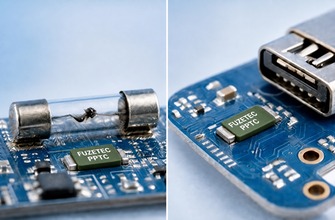
Picture a fuse that never needs replacing – one that quietly does its job, recovers on its own, and is ready for the next overcurrent condition before you have even noticed the first. That is the everyday magic of a PPTC Fuse.PPTC stands for Polymeric Positive Temperature Coefficient, and you will also see it sold as a polyfuse or resettable fuse – same device, different names. Inside sits a polymer matrix packed with conductive carbon-black particles. Under normal current it stays cool and remains low resistance; when an overcurrent strikes, the polymer PTC material heats up and resistance increases sharply to choke off the fault. Once the fault condition is removed, the PPTC Fuse resets itself.
Tip: Always leave a 20% margin between your normal load and the hold current to avoid nuisance trips.
→ Read the full breakdown of how PPTC works in PPTC Fundamentals
Resettable vs. One-Time Fuse: Which One Should Be on Your BOM?
Here is the question that decides your bill of materials: do you want a fuse that sacrifices itself, or one that lives to fight another day?A traditional one-time fuse opens permanently and cuts current to zero – fast, decisive, but it demands a physical replacement and incurs higher costs. A PPTC Fuse instead trips and resets automatically, trading a little speed for huge convenience. The trade-offs are real: PPTCs react in milliseconds rather than microseconds, allow a small residual leakage current even when tripped, and their resistance drifts slightly higher after each event. In return, a single PPTC Fuse can survive hundreds of trip cycles, while a one-time fuse survives exactly one.
→ See the full traditional fuse vs. PPTC comparison

How to Specify and Source the Right PPTC Fuse
You just need five numbers and a little context to write an RFQ that gets you the right part.
Start with the essentials on any PPTC Fuse datasheet: Vmax (maximum voltage), Imax (maximum current), Ihold (the current it carries without tripping), Itrip (where it trips), and time-to-trip.
Then account for temperature: ratings are specified at 23°C, and hold current can fall by roughly 50% at 80°C – so a 1A part may only hold 0.5A in a hot enclosure. One buyer learned this the hard way when fuses near a power regulator kept nuisance-tripping; derating fixed it overnight.
Next, choose a package – SMD for compact PCBs, radial-leaded for higher current, or battery strap for cell packs. Finally, request the certifications your market demands: IATF-16949 and AEC-Q200 for automotive.
Tip: When quoting a PPTC Fuse, always tell your supplier the ambient temperature and operating current – those two details prevent 90% of mis-orders.
→ Get the complete selection walkthrough in Comprehensive Guide to Selecting PPTC Resettable Fuses
Buying for a team or project? Explore the B2B procurement playbook: 10 strategic insights for PPTC before you finalize your sourcing strategy.