Table of Contents
Server Hot Swap Protection Starts Before the Power Pins Mate
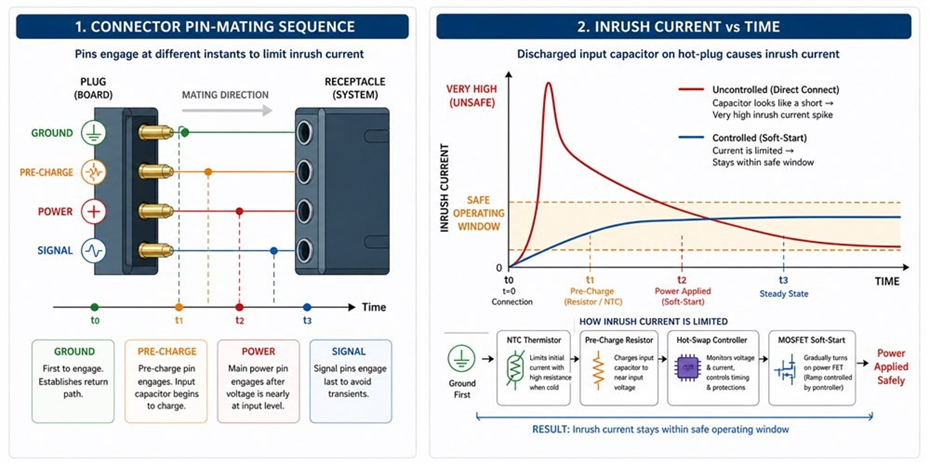
Server hot swap protection is a sequencing problem before it is a fuse problem. During insertion, ground, pre-charge, power, and signal pins do not connect at the same instant. A discharged input capacitor can demand a large inrush current from a live 48–54Vdc bus before the board is ready.If the sequence is not controlled, the result can be bus droop, connector arcing, upstream trip, MOSFET overstress, or disturbance to neighboring cards. The design must define what happens in the first milliseconds of insertion.
Inrush Current Needs a Dedicated Path
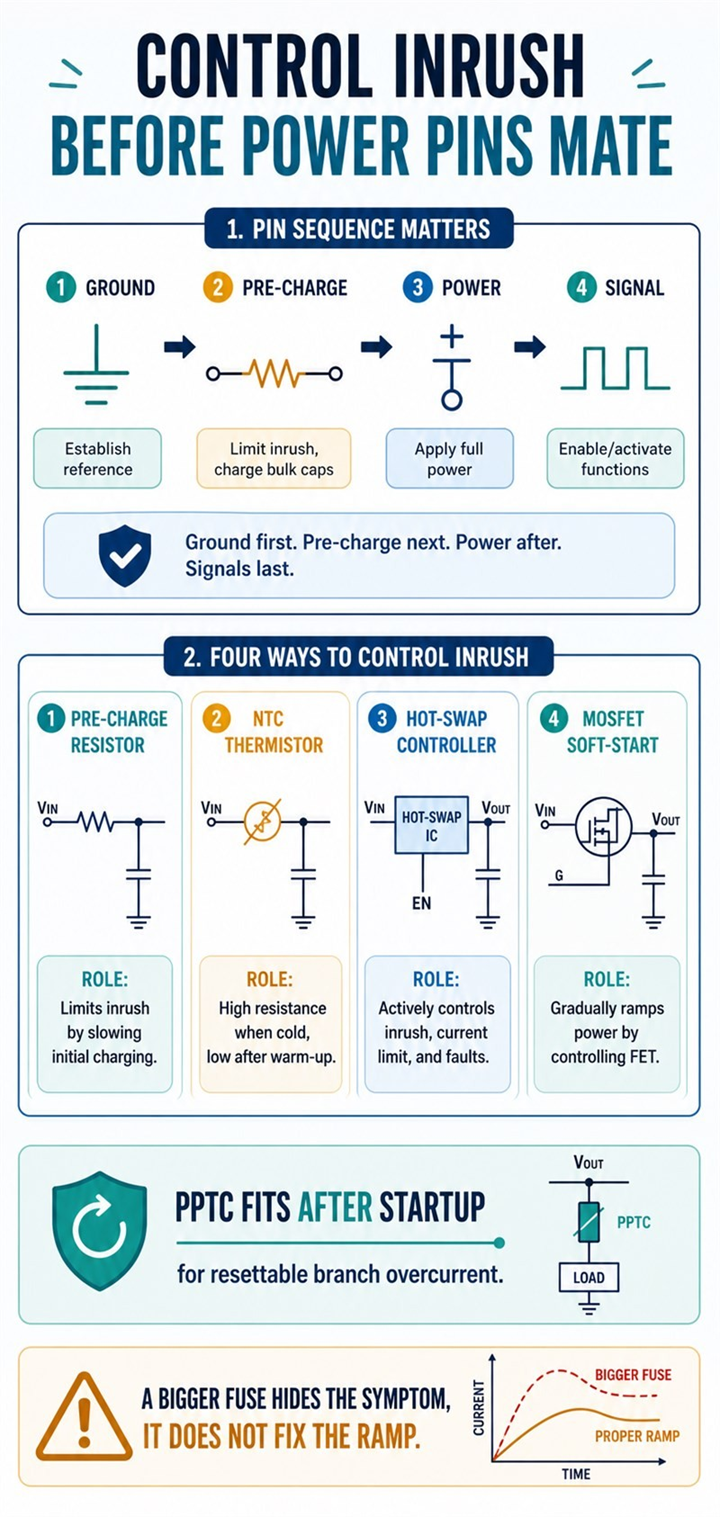
Inrush current is caused by charging input capacitance, not by steady-state load demand. It should be handled by pre-charge resistors, NTC thermistors, hot-swap controllers, or MOSFET soft-start. PPTC devices should not be described as the primary startup inrush limiter; their value is stronger after startup, when branch overcurrent or abnormal heating must be resettable.
The pre-charge path should limit current enough to protect connector plating and keep the bus stable. The main power path should close only after voltage is within the defined window.
Protection Pairing for Serviceable Cards
A serviceable server card usually needs ESD and transient protection on signal pins, controlled inrush current on the power input, reverse-current blocking where redundant paths exist, and steady-state overcurrent protection on branch loads. MOSFET SOA and thermal design are especially important because startup looks harmless only when the ramp is controlled.
PPTC resettable fuses can protect auxiliary loads, fan modules, storage cards, and secondary DC branches where service teams prefer recovery over replacement.
Hot-Swap Validation Items
• Measure peak inrush current and bus voltage droop during real insertion.
• Confirm pre-charge timing before main power pin engagement.
• Test high-temperature insertion and repeated insertion cycles.
• Verify that a failed card does not disturb adjacent live cards.
• Check that protection recovers only when the fault has actually cleared.
A server card can trip at insertion even when no component is defective because an uncharged input capacitor initially looks like a short circuit. The practical question is not whether inrush occurs, but how much current and energy the connector, backplane, MOSFET, and upstream supply can tolerate while the capacitors charge. The answer requires a time-domain measurement, not a nominal current estimate.
Separate the functions. A hot-swap controller and MOSFET can ramp the input voltage, monitor current, and disconnect on a fault. A pre-charge path limits the first capacitor charge. NTC is an option for inrush-current limiting where its temperature-dependent behavior fits the duty cycle. PPTC is not an inrush limiter: it belongs on lower-current secondary branches to protect post-startup steady-state overcurrent. The main 48–54Vdc bus needs fuse, eFuse, or solid-state breaker protection suited to its fault energy.
The MOSFET selection must include more than low RDS(on). During a slow ramp or short-circuit response it can spend time in its linear region, so check safe operating area, thermal impedance, controller gate drive, and the energy of repeated insertions. Check connector pin sequencing and make sure the return path and signal grounds cannot create an unintended arc. Mechanical insertion speed and contact bounce can produce waveforms that a bench supply never reproduces.
For a 48–54Vdc server card, measure card input capacitance, source impedance, pre-charge resistance, ramp time, peak current, and the voltage dip seen by neighboring loads. Then test insertion at minimum and maximum input voltage, cold and hot temperature, and after repeated cycles. An NTC that works on the first start may behave differently when already warm; an active controller may need timing and retry limits that match the rack policy.
Good hot-swap design protects availability as well as the card. The desired result is a controlled insertion, no excessive rail disturbance, prompt removal of a real fault, and a clear fault record for service. Coordinate it with ORing and PSU behavior so a local card event does not cascade into a rack reset.
Service procedures should be part of the validation. Confirm what happens when an operator inserts a card incompletely, removes it during a retry interval, or restores it after a fault latch. The controller should expose a useful status signal, and the protection sequence should be repeatable without relying on an uncontrolled power-cycle of the entire rack.
FAQ
Why does a server card trip only when inserted?Because insertion charges input capacitors and changes contact sequence, creating a brief high-current event before steady-state operation begins.
Can I fix hot-swap trips by using a larger fuse?
Usually no. A larger fuse may hide the symptom while increasing fault energy. Controlled pre-charge and soft-start are the real fixes.
Where does PPTC fit in hot-swap design?
PPTC fits after startup for resettable steady-state overcurrent or abnormal heating protection on branch loads.
Conclusion and CTA
Server hot swap protection succeeds when insertion timing, inrush current, connector stress, and branch protection are designed together. Fuzetec can help review PPTC, TVS, MOSFET, and hybrid protection for serviceable server cards.Suggested Internal Links
• PPTC resettable fuse selection guide: https://www.fuzetec.com/en/news-detail/pptc-resettable-fuse-selection-guide
• PPTC resettable fuse products: https://www.fuzetec.com/en/product-group/pptc-resettable-fuse
• power MOSFETs: https://www.fuzetec.com/en/product-group/power-mosfet
Tag