Overcurrent Protection vs Overvoltage Protection in Industrial Equipment: PPTC, TVS and MOV Cannot Be Mixed at Random

Table of Contents
Overcurrent protection in industrial equipment deals with abnormal current, such as overload, short circuit, miswiring or abnormal loads. Overvoltage protection deals with abnormal voltage, such as surge, ESD, lightning-induced transients, power switching, or transient voltage caused by inductive loads. PPTC resettable fuses, TVS diodes and MOV varistors are all protection devices, but they must not be treated as one interchangeable part type.
The most common selection mistake is not omitting a protection device, but handling "abnormal current" and "voltage transients" as if they were the same problem. Here is a hypothetical engineering scenario: an equipment maker was helping to troubleshoot control-board anomalies on a small automated inspection machine. The original plan on site was to increase the PPTC rating on the external I/O, because the protection device kept operating repeatedly. After the team measured the circuit section by section, they found that the external wiring harness ran close to the motor cabling, and long-cable coupling was creating transient interference on the signal side. The problem was not simply overcurrent; the protection location and the overvoltage protection had never been defined clearly in the first place.This article explains the difference between overcurrent protection and overvoltage protection from an industrial equipment design perspective, and organizes the respective roles of PPTC, TVS, MOV and Hybrid Protection. You will see which situations call for looking at current first, which situations require looking at transient voltage first, and which electrical, thermal and layout conditions you should prepare before talking to a supplier.
Key Takeaways
- Overcurrent protection in industrial equipment addresses overload, short circuit, miswiring and abnormal loads; overvoltage protection addresses transient voltage from surge, ESD, lightning-induced events and inductive load switching.
- The PPTC resettable fuse is used mainly for resettable overcurrent protection. According to Fuzetec PPTC technical articles, once abnormal current heats the device, its resistance rises to limit the current.
- MOV Varistor and TVS Diodes belong to the Fuzetec Overvoltage Protection product group. The former is commonly discussed for surge energy absorption; the latter is commonly discussed for fast transients and ESD protection.
- Hybrid Protection is worth including in the comparison when a single design must evaluate both overcurrent and overvoltage risk, but suitability still has to be confirmed against the datasheet, thermal conditions, layout and testing.
- The selection order should be: define the fault mode -> confirm voltage, current, energy and location -> choose the device category -> compare datasheets -> run prototype testing.
What Is Overcurrent Protection in Industrial Equipment?
The core question in overcurrent protection is "current exceeding the design condition." In industrial equipment, common sources include short circuits, overload, miswired external terminals, damaged sensor harnesses, load changes, motor stall, and abnormal solenoid or relay coils.For a hardware engineer, overcurrent protection is not only about normal operating current. You also need to look separately at standby current, inrush current, full-load current, short-circuit current, fault duration and ambient temperature.
The Role of PPTC in Overcurrent Protection
The PPTC resettable fuse is a resettable overcurrent protection device. According to Fuzetec's PPTC fundamentals, conductive particles are dispersed within the polymer structure of the PPTC material. Under normal conditions they form a conductive path; when abnormal current causes the device to heat up, the material state changes, resistance rises, and the current is limited.This behavior suits overcurrent scenarios that require repeated protection and where the fault can be removed. However, PPTC is not a synonym for "complete open circuit," and not every fault can be handled by the same device.
Fuzetec's PPTC selection guide lists selection factors including operating voltage, hold current (Ihold), trip current (Itrip), maximum voltage, maximum current, time-to-trip, thermal derating, environmental conditions, and safety/environmental requirements. These conditions must be considered together; Ihold alone is not enough.
Common Overcurrent Locations in Industrial Equipment
In industrial equipment, overcurrent protection commonly appears on control board power supplies, external I/O, sensor power, communication module power, low-voltage DC branches, and near terminals that field personnel are likely to wire or service.For example, one 24V control board output may feed several sensors at the same time. If loads are added in the field, the steady-state current may still be below the original estimate, but the operating point may come close to the boundary during startup or after long operation inside a high-temperature enclosure. Here, the selection issue lies not only in the nominal device current, but in whether the load scenario, temperature and time-to-trip curve have been confirmed together.
What Is Overvoltage Protection in Industrial Equipment?
The core question in overvoltage protection is "voltage exceeding what the downstream circuit can withstand." In industrial equipment, the source may be ESD, surge, lightning-induced events, power quality fluctuation, inductive load switching, or transient interference near relays and motors. The IEC page for IEC 61000-4-4:2012 also links the electrical fast transient/burst immunity test to the evaluation of immunity of electrical and electronic equipment to repetitive fast transients.This class of problem does not necessarily produce a large current for a long time. In many cases it is a short-duration, high-slew-rate or high-energy voltage event. If you think only in overcurrent terms, you may miss the real risk to downstream ICs, communication transceivers, sensors or MOSFET gates, and you may also place overcurrent protection devices where they do not belong.
The Basic Division of Labor Between MOV Varistor and TVS Diodes
Fuzetec's Overvoltage Protection product group includes MOV Varistor, TVS Diodes and Hybrid Protection. This means that when an article discusses surge, ESD, transient voltage protection or hybrid protection, these should be treated as different design tools, not as one single answer.MOV Varistor is usually placed in the discussion of surge and higher-energy transient absorption. Fuzetec's PPTC + MOV / TVS technical article also explains MOV in the context of transient voltage surge protection.
TVS Diodes are commonly used in discussions of fast transient voltage clamping and ESD protection. IEC 61000-4-2:2008 is the EMC standard for the electrostatic discharge immunity test; the IEC page states that its purpose includes establishing a reproducible basis for evaluating the performance of electrical and electronic equipment when subjected to electrostatic discharges. Actual design still has to return to the product application, test standards, datasheet and layout conditions.
Location Matters More Than the Device Name
Even within overvoltage protection, the requirements differ between the power input, the DC rail, external I/O, communication lines and sensor wiring. The power input may first require attention to surge energy and coordination with front-end protection; communication lines usually place more weight on ESD, parasitic capacitance and signal integrity; sensor wiring often faces miswiring, long-cable coupling and external environmental interference at the same time.So "should I use MOV or TVS" is not the first question. The first question should be: what voltage events will this node see? Where do those events enter from? What can the downstream devices withstand? And is the path from the protection device to ground or to the return short enough?
Overcurrent vs Overvoltage Protection in Industrial Equipment: An Engineering Decision Table
The table below can serve as the first layer of judgment for an industrial equipment protection architecture. It is not a part number selection table; it helps you first distinguish the fault type.| Comparison Item | Overcurrent Protection | Overvoltage Protection |
| Primarily addresses | Abnormal current | Abnormal voltage |
| Common causes | Overload, short circuit, miswiring, abnormal load | ESD, surge, lightning-induced events, inductive load switching, power fluctuation |
| Common device categories | PPTC resettable fuse, one-time fuse, etc. | MOV Varistor, TVS Diodes, Hybrid Protection, etc. |
| Key parameters | Operating voltage, Ihold, Itrip, Imax, time-to-trip, thermal derating | Operating voltage, clamping conditions, transient energy, package, parasitics, layout path |
| Location in industrial equipment | Control board power, I/O power, sensor power, external load branches | Power input, DC rail, communication lines, external I/O, sensor wiring |
| Common mistakes | Looking only at normal current while ignoring inrush current, short-circuit current and temperature | Adding a protection device while ignoring downstream withstand voltage, ground return and protection location |
Consider another hypothetical industrial automation protection scenario. The team of equipment maker Lina designed a remote I/O board. The first version placed a PPTC only on each external supply branch, because the biggest field concern was overcurrent from miswiring. In prototype testing the short-circuit protection performed as expected, but the communication interface still tended to reset abnormally under ESD test conditions. The team then separated the problems: the supply branches needed overcurrent protection, and the communication interface needed transient voltage protection. The two do not replace each other; they address different risks.
How Do PPTC, TVS, MOV and Hybrid Protection Divide the Work?
When engineers look at protection devices, they should first match the "fault mode" to the "device role," and only then move on to package, specification and part number comparison.PPTC: Handling Resettable Overcurrent Risk
The PPTC resettable fuse suits overcurrent scenarios that need resettable protection. Common issues include short circuits on external branches, abnormal loads, miswiring, or downstream module failure.During selection, confirm the following conditions:
- Whether the operating voltage matches the circuit condition.
- The relationship between normal load current and hold current (Ihold).
- The relationship between fault current and trip current (Itrip).
- Whether the maximum fault current falls within the device rating.
- Whether time-to-trip occurs before the damage threshold of downstream wiring or components.
- Whether thermal derating already accounts for cabinet temperature, PCB copper, nearby heat sources and package limits.
MOV Varistor: Handling Surge and Overvoltage Energy Risk
MOV Varistor is commonly used in discussions of surge and transient voltage protection, especially at the power input, the AC/DC front end, or other locations related to higher-energy events. Fuzetec lists MOV Varistor under the Overvoltage Protection product group.MOV selection is not just about "whether one is fitted." You need to confirm operating voltage, surge conditions, downstream withstand capability, thermal conditions, failure mode and protection coordination. The Fuzetec FCMOV article also notes that under certain sustained abnormal overvoltage conditions, the thermal risk of an MOV must be part of the design thinking.
TVS Diodes: Handling Fast Transients and ESD Protection
TVS Diodes are commonly used in discussions of fast transient voltage clamping and ESD protection. Typical locations include communication lines, external I/O, sensor interfaces, control signal lines, and areas near sensitive semiconductors.When selecting a TVS, in addition to operating voltage and clamping conditions, you also need to consider signal speed, line capacitance, package, ground path and layout. For high-speed or low-capacitance interfaces, the protection device itself may affect signal integrity, so you cannot select on a "higher withstand voltage is always better" basis.
Hybrid Protection: When Current and Voltage Risks Must Be Handled Together
Hybrid Protection suits design discussions where overcurrent and overvoltage must be evaluated at the same time. Fuzetec's PPTC + MOV / TVS technical article explains that a PPTC can be combined with an MOV or TVS to form a hybrid protection concept, handling overcurrent risk and transient voltage risk respectively.Fuzetec's FCMOV article also takes the PPTC + MOV hybrid overvoltage protection device as its subject, discussing overvoltage / overcurrent protection and MOV thermal risk. That said, such content should be interpreted in the context of that product and application, and should not be generalized into the assumption that the same architecture suits every application.
Ready to start narrowing down part numbers? First organize your operating voltage, normal current, possible fault current, transient sources, ambient temperature and protection location, then use Fuzetec's product search to compare the available categories.
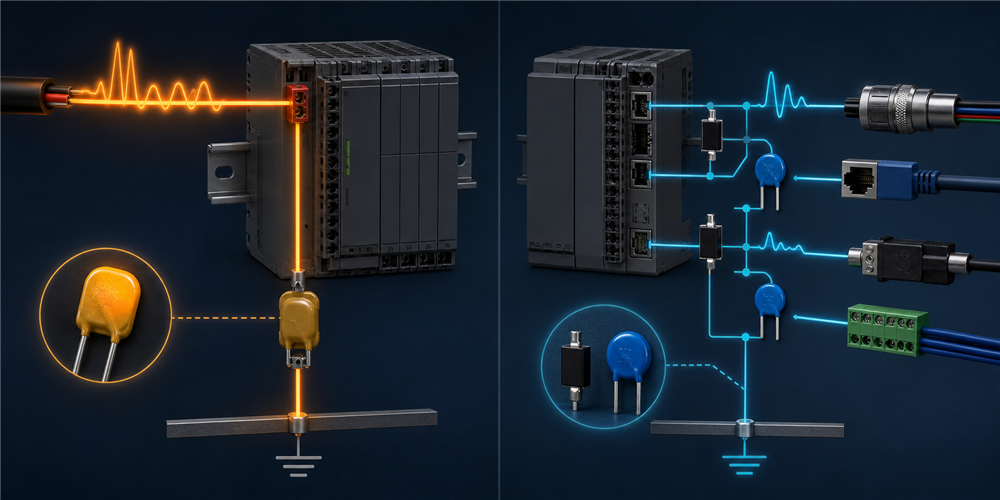
How Should You Look at Common Protection Locations in Industrial Equipment?
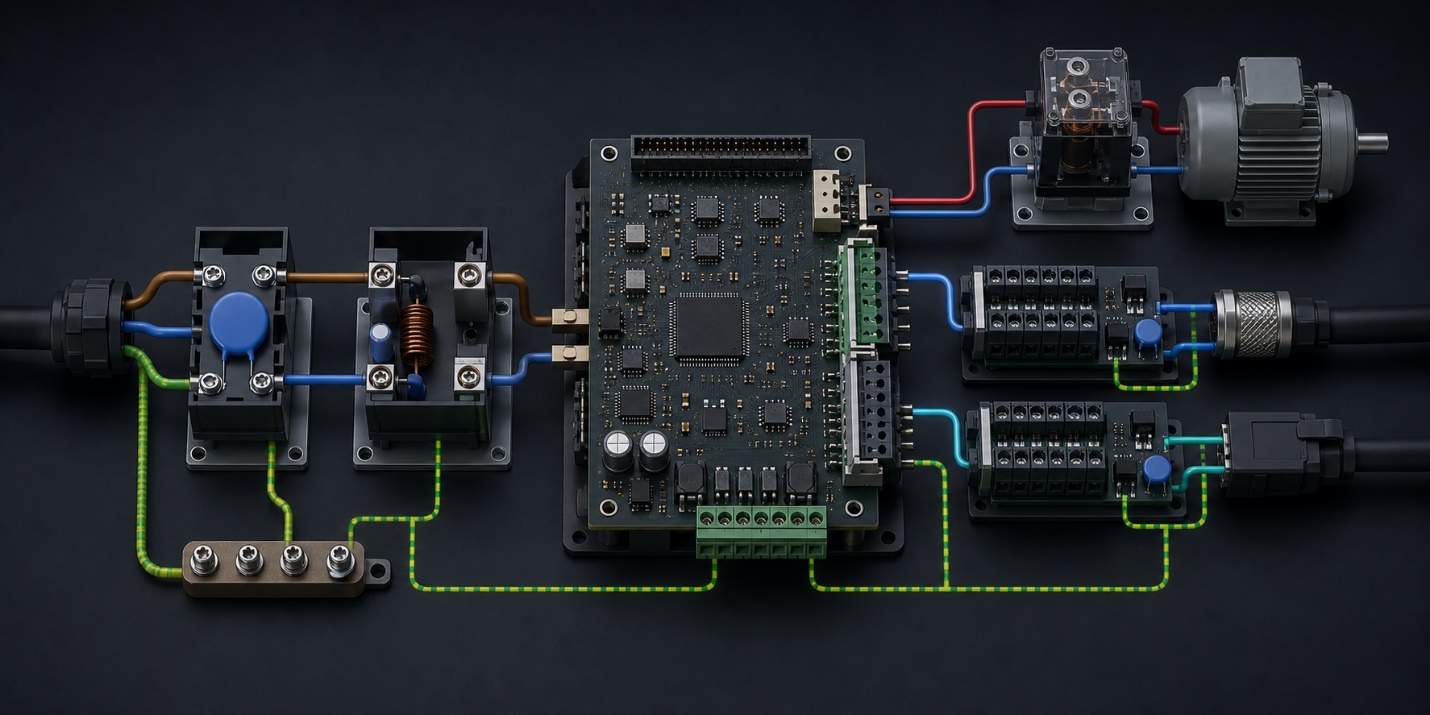
The role of a protection device is often determined by where it is placed. The following are common design locations in industrial equipment.Power Input
The power input is usually the first to face transient events caused by external power quality, surge, lightning-induced events or the distribution environment. Overvoltage protection here often brings MOV Varistor or Hybrid Protection into the discussion.But the power input may also need overcurrent protection, especially when a downstream short circuit or miswiring could subject the input branch to abnormal current. At that point you must be clear about which device handles the voltage event and which device handles the current event.
DC Power Rail
The DC power rail typically supplies controllers, sensors, communication modules, driver circuits or other downstream loads. If an external terminal is shorted, overcurrent protection may be the focus; if inductive load switching or long-cable coupling creates transients, overvoltage protection must be included as well.Such nodes often require you to look at steady-state current, transient sources, downstream IC withstand capability and PCB layout together. If a protection device sits too far from the node being protected, or the return path is too long, the protection result may deviate from expectations.
I/O and Sensor Wiring
I/O and sensor wiring is the most exposed to field factors. Miswiring during maintenance, harnesses pulled by mechanical parts, moisture at terminals, or specification changes in external modules can all cause overcurrent or transient voltage problems.Here is another hypothetical troubleshooting scenario. Engineer Wei encountered a control box close to mass production. All lab tests passed, but after the sensor cabling was replaced in the field, intermittent hangs occurred. The team first suspected MCU firmware, but an oscilloscope later captured transients when the external cable was plugged and unplugged. The final direction was not to increase the PPTC current, but to re-examine the transient voltage protection, grounding and harness routing at the I/O side.
Communication Interfaces
RS-485, CAN, Ethernet or other external communication interfaces usually place greater emphasis on ESD protection, common-mode interference, parasitic capacitance and layout. When communication cables extend outside the equipment, the risk from ESD and long-cable coupling rises.Such lines should not be considered from an overcurrent perspective alone. If the capacitance or layout of the protection device is unsuitable, signal quality may suffer; if the protection path is too long, transient voltage may still reach the transceiver.
Near Motors, Relays and Solenoid Valves
Motors, relays and solenoid valves are common inductive loads in industrial equipment. Switching can produce transient interference, and stall, abnormal coils or jammed loads can produce overcurrent.These areas require two things to be considered together: how switching transients are suppressed, and how abnormal load current is limited. If only one of the two is addressed, the equipment may still show malfunctions, resets, component overheating, or repeated operation of protection devices.
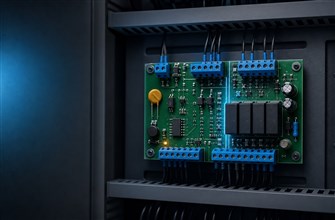
Common Overcurrent Protection Mistakes in Industrial Equipment: PPTC, TVS and MOV Cannot Be Mixed at Random
Mismatched protection devices usually result from design requirements that were never clearly separated. The following mistakes are very common in industrial equipment design.Mistake 1: Using PPTC in Place of a Voltage Clamping Device
The main role of a PPTC is overcurrent protection. It heats up under abnormal current and increases its resistance to limit the current. It is not a device for rapidly clamping ESD or transient voltage.If the source of the problem is ESD on a communication line, or transient voltage from inductive load switching, simply increasing the PPTC rating usually will not solve the root cause. In that case you should evaluate TVS Diodes, MOV Varistor or another suitable overvoltage protection architecture.
Mistake 2: Fitting Only an MOV Without Considering Sustained Abnormal Overvoltage or Thermal Risk
MOVs are commonly discussed for surge protection, but fitting one is not the end of the job. If the application may face sustained abnormal overvoltage, repetitive surges or a poorly ventilated environment, you need to check failure mode, thermal conditions and protection coordination.The value of the Fuzetec FCMOV article is exactly that reminder to engineers: in certain situations, MOV thermal risk and overcurrent coordination must be considered together. Whether it actually suits your case still has to be confirmed against product data and application testing.
Mistake 3: Making a TVS Absorb Long-Duration Energy Beyond Its Datasheet Capability
TVS Diodes are commonly used for fast transients and ESD protection, but that does not mean one can absorb every long-duration or high-energy event. If a TVS is placed in the wrong location, or subjected to energy beyond its datasheet conditions, the protection design can still fail.During selection, confirm the transient source, waveform conditions, downstream withstand voltage, package thermal capability and layout. Where necessary, front-stage protection and downstream clamping should be coordinated, instead of putting all the stress on a single device.
Mistake 4: Ignoring PPTC Thermal Derating and Time-to-Trip
PPTC behavior is temperature dependent. The inside of a control cabinet, proximity to power devices, a sealed enclosure and long periods of full-load operation can all change the usable hold current.If you select using room-temperature data only, nuisance tripping may occur at high field temperatures. If you look only at Ihold without checking Itrip, Imax, Vmax and time-to-trip, protection may be insufficient when a real fault occurs.
Mistake 5: Ignoring Layout, Ground Path and Protection Device Placement
Overvoltage protection is especially dependent on layout. If a TVS or MOV is too far from the node being protected, or the ground/return path is too long, the transient event may already have reached the downstream circuit.Overcurrent protection is likewise affected by layout and heat. PCB copper, pads, nearby heat sources and cooling conditions can all influence the actual temperature and operating behavior of a PPTC.
Engineer's Selection Checklist: Define the Fault First, Then Choose the Device
Before contacting a supplier or starting part number screening, it is worth organizing the following information. This is more effective than simply asking "can you recommend a PPTC" or "which is better, MOV or TVS."- Is this risk a current anomaly, a voltage anomaly, or both?
- What are the normal operating voltage, maximum possible voltage and downstream withstand conditions?
- What are the normal current, inrush current, full-load current, fault current and short-circuit current?
- Is the transient source ESD, surge, inductive load switching, long-cable coupling or a power quality issue?
- Is the protection located at the power input, DC rail, I/O, sensor wiring or communication interface?
- Have ambient temperature, cabinet cooling, PCB space and nearby heat sources been taken into account?
- Do you need resettable protection, one-time disconnection, or Hybrid Protection that considers both overcurrent and overvoltage?
- Has everything been confirmed against the datasheet, thermal derating curve, protection level, layout and prototype testing?
Which Protection Device Categories Can Fuzetec Support?
The official Fuzetec product categories include PPTC Resettable Fuse, Overvoltage Protection and Power MOSFET. The focus of this article is overcurrent and overvoltage protection in industrial equipment, so the emphasis is on the first two.PPTC Resettable Fuse
The PPTC Resettable Fuse product group includes Radial Leaded PPTC, SMD PPTC, High Voltage Series, High Temperature Series, Battery Strap, and Chip & Disc PPTC. When the design requirement is resettable overcurrent protection, Ihold/Itrip, thermal derating or package selection, this category is the place to start.Overvoltage Protection
The Overvoltage Protection product group includes MOV Varistor, TVS Diodes and Hybrid Protection. When the design requirement is surge protection, ESD protection, transient voltage protection or hybrid protection, this category is the place to start.Power MOSFET
If the article or project goes further into power paths, switching efficiency, RDS(on), gate charge or thermal management, it becomes appropriate to extend into Power MOSFET. For this article, Power MOSFET is related but not the main subject.FAQ
Can overcurrent protection and overvoltage protection be handled by the same device?
Not necessarily. Overcurrent protection addresses current anomalies, overvoltage protection addresses voltage anomalies. If a design faces both risks, you can evaluate multi-stage protection or Hybrid Protection, but you cannot assume a single device covers every failure mode.Can a PPTC protect against ESD?
The main role of a PPTC is resettable overcurrent protection, not fast ESD voltage clamping. If the issue is ESD protection or fast transient voltage, you usually need to evaluate TVS Diodes, layout and the ground path.Which is more suitable for industrial equipment, MOV or TVS Diodes?
It depends on the protection location and transient conditions. MOV Varistor is often discussed for surge and higher-energy events; TVS Diodes are often discussed for fast transients, ESD and protection of sensitive signal lines. Actual selection must be confirmed against operating voltage, downstream withstand conditions, energy, package, layout and testing.Does an industrial control board always need PPTC, MOV and TVS together?
Not necessarily. The protection architecture should start from the fault mode. If the only risk is a removable overcurrent condition, PPTC or another overcurrent protection may be the first thing to look at; MOV, TVS or multi-stage protection only need to be evaluated when there is power surge or ESD on external cabling.When is Hybrid Protection worth considering?
When the same design location or the same module has to handle both overcurrent and overvoltage risk, Hybrid Protection can be included in the comparison. Examples include the power input, modules easily exposed to the external environment, or designs that need to coordinate MOV thermal risk with overcurrent behavior. Even so, suitability still has to be confirmed against the datasheet and testing.Conclusion: Don't Ask Which Device First, Ask What the Fault Is
The difference between overcurrent and overvoltage protection in industrial equipment lies in the fundamentally different faults they address. Overcurrent protection looks at abnormal current and thermal behavior; overvoltage protection looks at surge, ESD, transient voltage and downstream withstand capability.PPTC, TVS, MOV and Hybrid Protection may all appear in an industrial equipment protection architecture, but they are not interchangeable universal answers. The correct process is to define the fault mode first, then confirm voltage, current, energy, location, temperature, package and layout, and finally confirm against the datasheet and prototype testing.
If you are evaluating the protection design of an industrial control board, power module, I/O, sensor or communication interface, first organize your operating voltage, normal load current, possible fault current, transient sources and ambient temperature, then use Fuzetec product search or contact us to confirm suitable product categories and selection direction.
Sources
- Fuzetec PPTC Resettable Fuse product group: https://www.fuzetec.com/en/product-group/pptc-resettable-fuse
- Fuzetec Overvoltage Protection product group: https://www.fuzetec.com/en/product-group/overvoltage-protection
- Fuzetec Power MOSFET product group: https://www.fuzetec.com/en/product-group/power-mosfet
- Fuzetec PPTC selection guide: https://www.fuzetec.com/en/news-detail/pptc-resettable-fuse-selection-guide
- Fuzetec PPTC fundamentals: https://www.fuzetec.com/en/news-detail/pptc-resettable-fuse-fundamentals
- Fuzetec PPTC + MOV / TVS article: https://www.fuzetec.com/en/news-detail/pptc-resettable-fuse-mov-varistor-tvs-diode
- Fuzetec FCMOV article: https://www.fuzetec.com/en/news-detail/pptc-mov-tmov
- IEC 61000-4-2:2008, Electrostatic discharge immunity test: https://webstore.iec.ch/publication/4189
- IEC 61000-4-4:2012, Electrical fast transient/burst immunity test: https://webstore.iec.ch/en/publication/4222
Tag